




B2B Appointment Setting Services
That Convert
While other B2B appointment setting companies over promise and under deliver by chasing dial count, our US-based team focuses on quality conversations with decision makers that turn into closed revenue. That's why our clients see 3x higher close rates—and keep coming back.


181%
Increase in Sales Opportunities
80%
Client Retention Rate (18+ months)
Up to
25%
Contact Rate with Decision Makers
2013
Trusted Partner to B2B Leaders
What's Included
Everything your sales team needs to close more deals. Nothing they don't.

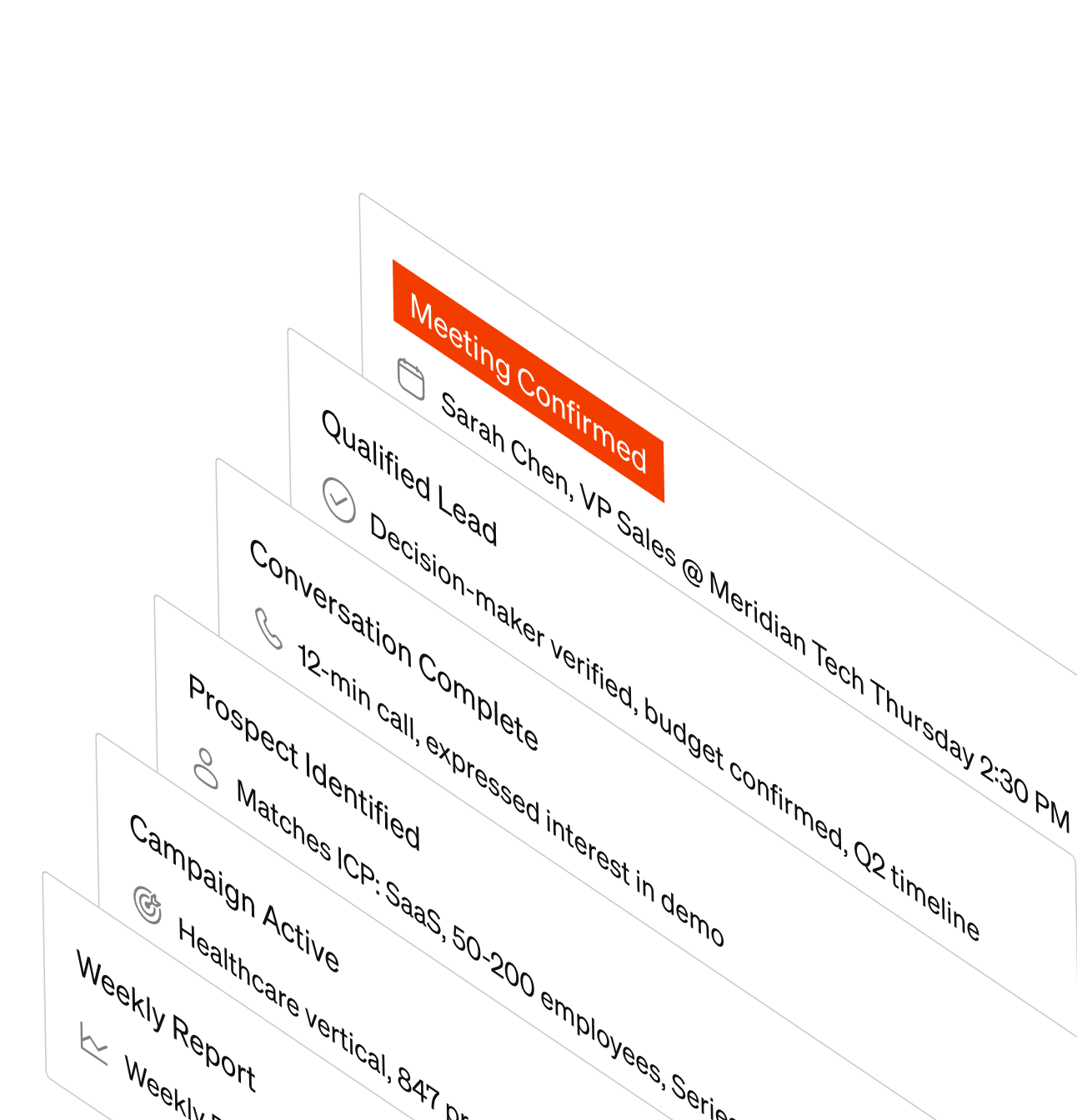
Sales-Qualified Appointments
Meetings with decision-makers who have budget, authority, and genuine interest. Every prospect is qualified/disqualified using your specific qualifying criteria before it reaches your calendar.
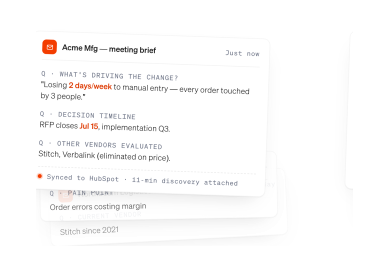
Detailed Lead Notifications
Your team walks into each meeting well-prepared. Each brief includes your specific qualifying questions and responses captured, and other sales & marketing intelligence.
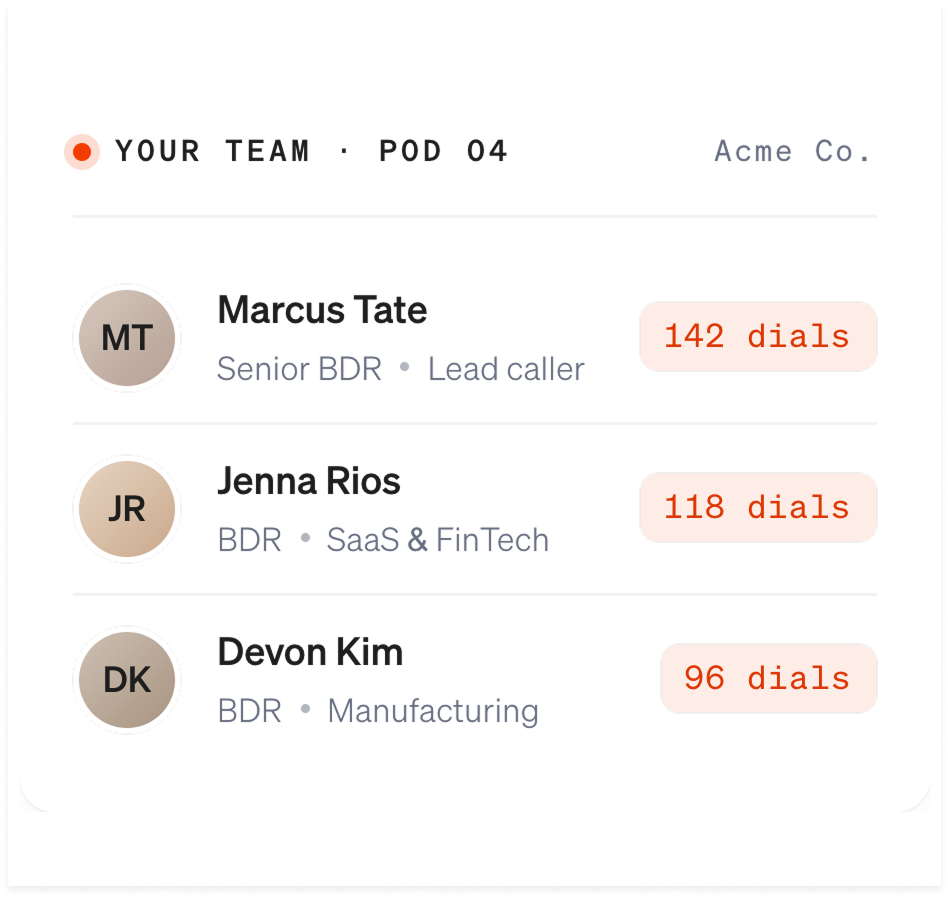
Dedicated SDR Team
A dedicated US-based, native English speaking SDR team assigned to you. They learn your business, your value proposition, and your ideal customer inside and out.
Calendar Integration
Appointments booked directly to your team's calendar. No back-and-forth. No friction. Just qualified meetings ready to happen.
.png)
Weekly Review Sessions & Reporting
Full transparency of activity, results, and leading indicators using call recordings and A/B Testing. You'll always know exactly what's working and what we are optimizing. We can even integrate directly with your internal CRM and provide real-time updates.
.png)
Ongoing Optimization
Call flows, A/B Testing, targeting, and outreach sequences are discussed and refined weekly based on real conversion data. The longer we work together, the better results get.
.png)
Our Process
How we fill your pipeline
Our proven B2B appointment setting process delivers well-qualified opportunities without overwhelming your team
1

Strategy Session
We start by understanding your business, ideal customer profile, and what a successful appointment looks like for your team.
30-minute discovery call
Define qualification criteria
Set success metrics
2

Launch & Optimize
Your dedicated US-based BDR team begins outreach with proven scripts and multi-touch sequences. We refine weekly based on results.
Dedicated BDRs assigned
Weekly review session and KPM reports
On-going optimization, refinement, and A/B Testing
3

Close Deals
Your sales team receives warm, well-qualified appointments with prospects ready to learn more about your products/services and how it can solve their problems.
Well-qualified appointments
Detailed notes/comments with sales & marketing intellegence
Sales calendar integration
Most clients see their first qualified appointments within 2-4 weeks of launch.
Schedule a Conversation
Why Leads at Scale
Most appointment setting companies measure success in activity. We measure it in warm, well-qualified appointments.
That's why we focus on quality 1:1 conversations over activity - achieving a 17.5% meaningful conversation rate versus the 2-3% industry average. It's why every call is made by US-based professionals with exceptional active listening skills. And it's why 80% of our clients stay with us for 18 months or longer.
We're not the cheapest option. We're the one that actually works.
Learn About Outbound Sales
RESULTS
B2B appointment setting success stories
Comprehensive outbound solutions to fill your pipeline with well-qualified opportunities

Outbound Calls:
10,200
Appointments:
425
"Exceeded our expectations in every
project. Exceptional preparation and impressive listening skills."
Felix Littschwager
Sr. Manager, Inside Sales

Outbound Calls:
20,643
Appointments:
516
"Our sales continue to double in size year over year. The combined effort has and continues to pay dividends."
Fred Dohmann
CEO

Outbound Calls:
31,425
Appointments:
220
"We have not only been very happy with their service & support but have realized increased sales and additional revenue."
Charlie Niemi
Owner, JanPro Northwest
First qualified appointments typically within 2-4 weeks
Schedule a Conversation
Is This Right for You?
Our B2B appointment setting services work
best for companies who:
Sell B2B with average deal sizes of $10K or more
Have a sales cycle that involves multiple conversations
Need to reach more of their total addressable market
Value qualified appointments over raw activity
Wants a partner who understands and supports their business, not just another vendor.
Industries we serve:
Manufacturing are
Technology & SaaS
Financial Services
Professional Services
Healthcare
Not sure? A quick conversation will tell us both. No pressure—just clarity.
Check Your Fit With a Discovery Call
FAQ
Common Questions
How many appointments can I expect each month?
It depends on your target market and ideal customer profile. During our strategy session, we'll set realistic expectations based on your specific situation. What we guarantee: every appointment will meet your qualification criteria.
What makes you different from other appointment setting companies?
Three things. First, we focus on quality—our 17.5% conversation rate is 5x the industry average. Second, every call is made by US-based, native English speaking professionals.. Third, we measure success in warm, well-qualified appointments not activity. That's why 80% of our clients stay 18+ months.
How do you qualify prospects?
We use your specific qualifying criteria. Additionally, we identify budget, authority, timeline, and any other factors that matter to your sales process. Our BDRs verify these through genuine conversation before scheduling any appointment.
Who makes the calls?
US-based, native English-speaking Sales Development Specialists. 100% of our SDRs are blind or visually impaired, bringing exceptional active listening skills, great communication skills, and greater interest and empathy that translate into better conversations with your prospects.
How quickly can we get started?
Our set-up, implementation, and on-boarding process typically takes 2-4 weeks from the time of initial agreement to the calls being made.
What information do I get about each appointment?
Every appointment comes with a detailed lead notification that includes prospect contact information, detailed call history and notes, qualifying questions and response captured, and who will be attending the meeting.
Do you guarantee a certain number of appointments?
We don't guarantee arbitrary numbers because we focus on quality. We do however know, understand, and develop expected benchmarks of success.
Can you integrate with our CRM?
Yes. We can book appointments directly to your team's calendars and integrate with most major CRM systems. We'll discuss your tech stack during the strategy session.
What if we need to scale up or down?
Flexibility is built in. We can adjust your program based on your pipeline needs, seasonal demands, or growth targets. That's part of being a true partner.
What does pricing look like?
Pricing is based on your goals, objectives, budgets, and timeframes, as well as the scope of outreach needed. We'll provide a custom quote after understanding your situation in our strategy session. No surprises, full transparency.
Explore Our Other Services
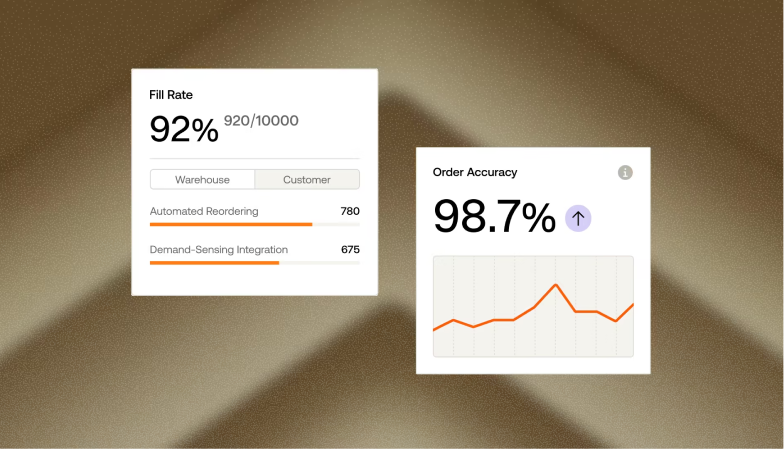
B2B Cold Calling Services
High-volume outreach without the overhead. Our US-based team makes thousands of targeted calls monthly, identifying interest and qualifying prospects.
Learn More
B2B Cold Calling Services
High-volume outreach without the overhead. Our US-based team makes thousands of targeted calls monthly, identifying interest and qualifying prospects.
Learn More
B2B Cold Calling Services
High-volume outreach without the overhead. Our US-based team makes thousands of targeted calls monthly, identifying interest and qualifying prospects.
Learn More

John Dubay
Founder, Leads at Scale
Let's Talk About Your Pipeline
In a 25-minute strategy call, we'll discuss your ideal customer, your current pipeline challenges, and whether our approach is the right fit. No pitch, just a real conversation about what you need.
Or call directly: 443-299-6029
Schedule a Strategy Call
