

The 'Warm Call' Strategy: How to Use Email & LinkedIn to Triple Your Cold Call Success Rate

The ‘Warm Call’ Strategy: How to Use Email & LinkedIn to Triple Your Cold Call Success Rate

Cold calling is losing its edge. With response rates for B2B cold emails dropping to 5.1% and only 1% of sales calls leading to appointments, it’s clear that traditional methods aren’t cutting it anymore. Enter the warm call strategy – a smarter way to approach sales by targeting prospects who already recognize your brand or have shown interest.

Here’s what makes warm calling effective:

  • Higher conversion rates: Warm leads convert 50% more often than cold ones, with success rates between 30–50%.
  • Shorter sales cycles: Warm calls can reduce the sales process by 32%.
  • Better efficiency: Fewer attempts are needed compared to cold calling, saving time and energy.

Warm calls rely on email and LinkedIn to establish familiarity and trust before picking up the phone. Personalized emails, LinkedIn connections, and thoughtful engagement with prospects’ content help lay the groundwork for meaningful conversations. By combining these tools, you can turn cold prospects into warm leads and significantly improve your outreach success.

This strategy isn’t just about making calls – it’s about building relationships, using data to qualify leads, and creating a multi-channel approach that works. If you’re tired of the low returns from cold calling, warm calling offers a more effective path forward.

How to Cold Call WARM Leads: Best techniques for success.

Writing Personalized Emails for Warm Calls

When it comes to warm call strategies, personalized emails play a crucial role in building genuine connections that encourage prospects to pick up the phone. The stats back this up: personalized emails can boost response rates by an impressive 112% compared to generic ones, and emails with personalized subject lines are 26% more likely to get opened.

Key Rules for Personalizing Emails

Effective email personalization starts with solid research. Dig into platforms like LinkedIn, Twitter, and company blogs to uncover recent achievements or challenges in the prospect’s industry. Look for common ground – maybe a shared connection or an industry event you both attended. Instead of focusing entirely on your product, tailor your message to their specific needs or goals. Show how your outreach aligns with their challenges or growth plans, offering clear value and actionable takeaways.

How to Structure Emails for Better Engagement

Once you’ve nailed the personalization, structuring your email the right way can make all the difference. A simple three-part framework – opening, middle, and closing – works wonders for engagement.

  • Start with a strong subject line and purpose: A compelling, specific subject line grabs attention. For example, a marketing agency saw a 15% boost in open rates after switching from vague lines like "Important Update" to targeted ones like "Your Performance Report is Ready".
  • Provide value in the middle: This is where you demonstrate your understanding of their business. Offer something useful, like insights or solutions tailored to their needs. For instance, a SaaS company saw better engagement when they included a brief explanation of how their product could help. Keep it focused on benefits and relevance.
  • End with a clear call to action (CTA): Close with a direct next step, like scheduling a demo. A sales team increased response rates by 25% by including a specific CTA. Make it easy – suggest times or include a direct link to your calendar.

Keep your emails concise – 100 to 200 words is the sweet spot – and format them for easy reading.

Using Email Analytics to Find Warm Leads

Once your emails are personalized and well-structured, analytics can help pinpoint which prospects are ready for a warm call. Tracking engagement metrics like opens, clicks, and page visits turns guesswork into a data-driven process.

Pay attention to prospects engaging with high-interest pages, such as pricing or product comparisons – these behaviors often signal serious buying intent. Use lead scoring to rank prospects based on their activity. Businesses that excel at lead nurturing generate 50% more sales-ready leads while cutting costs per lead by 33%. In fact, lead scoring has been shown to increase email marketing revenue by 41%, while also reducing unqualified leads by 52%.

Segment your leads into hot, warm, and cold categories based on their engagement. Focus your calls on hot leads while nurturing warm ones with helpful content. With 73% of B2B leads not yet sales-ready, clear segmentation ensures your time is spent wisely.

Timing is everything. Following up with web leads within five minutes can boost your chances of qualifying them by eight times. Use real-time analytics to spot when prospects are most engaged, then reach out promptly to capitalize on their interest.

Building Relationships with Prospects on LinkedIn

LinkedIn is a powerful platform for turning cold prospects into warm connections. It allows you to build trust and establish rapport before making a call, so when you do pick up the phone, it feels more like a natural continuation of the conversation rather than an unexpected interruption. By incorporating LinkedIn into your outreach strategy, you can set the stage for more productive phone calls.

Sending Personalized Connection Requests

Your connection request is the first impression you make, so it’s worth getting it right. Short and to the point works best – requests under 200 characters have a 25% higher acceptance rate, with 150-175 characters being the sweet spot. This forces you to craft a message that’s both concise and impactful.

The trick is to balance brevity with personalization. Avoid generic messages and instead focus on specific details from their profile, like mutual connections, shared interests, or recent achievements. A simple formula works well: mention something you have in common, explain why you’re reaching out, and skip the sales pitch.

"A LinkedIn connection request is more than just an action – it’s an opportunity." – Colleen McKenna, Intero Advisory, LLC

Here are a couple of examples to guide you:

  • If you met them at an event: “Hi [Name], it was great speaking with you at [Event Name] yesterday. I enjoyed our chat about [Topic] and would love to stay in touch here”.
  • If you’re reaching out to an industry peer: “Hi [Name], I work with [Your Company] in [Industry], and your recent work in [Topic/Field] really caught my eye. I’d love to connect and learn more about your approach”.

Before hitting “send,” do your homework. Review their LinkedIn activity, recent posts, and profile details to find genuine connection points. This extra effort shows respect for their time and increases the likelihood of acceptance. And don’t forget to proofread – typos can undermine your professionalism in an instant.

Once you’ve connected, the focus shifts to engaging with their content to keep the relationship growing.

Engaging with Prospects’ LinkedIn Posts

After connecting, interacting with their posts is a great way to deepen the relationship. Generic likes and comments won’t cut it – your engagement should be thoughtful and show genuine interest in their work.

Start by following their activity to stay updated on what they’re sharing. Their posts can reveal key insights about their challenges, interests, and business goals, all of which can serve as conversation starters for future calls. When they post industry insights or company updates, a well-crafted comment positions you as a knowledgeable peer, not just another salesperson.

Timing is everything. Engage with a few of their posts before sending a connection request to get on their radar. After connecting, maintain regular interaction by sharing relevant articles, offering helpful insights, or asking meaningful questions that spark dialogue.

The goal is to build authentic rapport through consistent, value-driven interactions. When you eventually call, you’re no longer a stranger – you’re someone they recognize as part of their professional network.

"Social selling tactics work best with LinkedIn, not direct salesy cold contacting. Make sure you provide the person value first with your content, insights, stats, etc., and only then you may approach them with a request to have a cup of (virtual) coffee and start talking business." – Tom Laine, LinkedIn, social recruitment and employer branding expert

These interactions not only strengthen the relationship but also provide valuable context for qualifying leads effectively.

Using LinkedIn Data for Lead Qualification

LinkedIn profiles are a treasure trove of information that can help you qualify leads and tailor your approach before reaching out. By pre-qualifying prospects, you avoid wasting time on poor fits and ensure your conversations are relevant and targeted.

Key factors to consider include job title, company size, industry, and experience. Pay attention to keywords in their profile and their posted content for clues about their priorities or challenges. Their engagement habits – what they post, comment on, or share – can also reveal their interests and communication style.

Company details add another layer of insight. Beyond basics like size and industry, look into their growth trends, recent news, and market position. Tools like Crunchbase or ZoomInfo can complement LinkedIn data by providing additional metrics like revenue and funding information.

AI-powered tools are making lead qualification even more efficient. Companies using these technologies report a 25% increase in conversion rates and a 30% reduction in sales cycles. These tools analyze data and assign scores based on your ideal customer profile, streamlining the qualification process.

For a consistent approach, create a simple scoring system. Assign points for factors like job relevance, company fit, engagement level, and alignment with your solutions. This framework helps you focus your efforts on high-potential prospects.

Using LinkedIn data to pre-qualify leads gives you a significant advantage. When you understand a prospect’s background, challenges, and preferences before the call, you can tailor your conversation to resonate with them from the start, showing that you’ve done your homework and genuinely understand their needs.

sbb-itb-ee13fa1

Combining Email and LinkedIn for Warm Calling Success

When you combine email and LinkedIn outreach, you create a seamless process that builds trust and familiarity with potential clients. This coordinated approach ensures that your eventual phone call feels like a natural progression, rather than an interruption. By engaging across multiple channels, you increase your visibility and establish credibility, making the conversation flow more smoothly.

Here’s a breakdown of how to combine these platforms effectively.

A Step-by-Step Workflow for Warm Calling

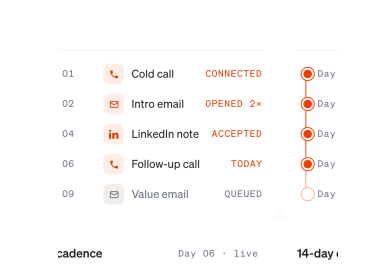
To turn a cold outreach into a warm conversation, timing and consistency are everything. Below is a 30-day sequence that integrates email, LinkedIn, and phone outreach into a cohesive plan:

  • Day 1: Start with a personalized email, addressing a specific problem and offering a solution. Short, concise emails have been shown to boost response rates by 51%.
  • Day 2: Send a LinkedIn connection request, referencing your email without being overly persistent.
  • Day 3: Make your first phone call. Mention the email and leave a brief voicemail if needed.
  • Day 7: Follow up on your LinkedIn request with a message. Share an industry insight or a relevant article to add value.
  • Day 10: Send a second email, this time featuring a case study or success story.
  • Day 12: Make another call and reference the case study you shared earlier.
  • Day 15: Send a LinkedIn message with a helpful article or resource, positioning yourself as a knowledgeable contact.
  • Day 18: Follow up with a short, focused email.
  • Day 21: Place another phone call.
  • Day 25: Share a LinkedIn message highlighting a recent achievement or project relevant to their industry.
  • Day 30: Wrap up with a final email. Offer value and politely ask if they’d prefer you to stop reaching out.

Why this works: Research shows it often takes 8 touchpoints to secure an initial meeting with a new prospect, though top performers can sometimes succeed in as few as 5 touchpoints. Keeping interactions spaced no more than three days apart and consistently adding value is key to success.

Using CRM Tools to Track Interactions

Without proper tracking, managing a multichannel strategy like this can quickly become overwhelming. That’s where a good CRM system comes in – it helps you stay organized, maintain timing, and avoid losing track of prospects.

The right CRM will log every interaction, from emails and LinkedIn messages to phone calls and voicemails. This gives you a clear view of how each prospect is engaging, allowing you to tailor your approach based on real-time feedback. For instance, companies using email tracking tools see 32% higher response rates compared to those that don’t.

Modern CRMs with LinkedIn integration can streamline your process even further by syncing contact details, profile updates, and activity automatically. This eliminates tedious manual updates and ensures your data stays current. When selecting a CRM, consider your team’s size and needs – larger organizations may require advanced customization, while smaller teams might prefer simpler, user-friendly options.

CRM Best For Key Strength Pricing
HubSpot Small to large businesses Lead generation and engagement tools Starts at $15 per user/month
Salesforce Enterprise-level teams Advanced automation and customization Starts at $25 per user/month
Pipedrive Sales-driven teams Pipeline management with LinkedIn integration Starts at ~$13 per user/month
Zoho CRM Small to medium businesses Custom workflows and LinkedIn profile enrichment Starts at ~$15 per user/month
Agile CRM Small to medium businesses Automation with LinkedIn notifications Starts at $9.99 per user/month

A CRM also allows you to segment your prospects based on engagement levels. For example:

  • Highly engaged: Prospects who open emails and respond on LinkedIn.
  • Moderately engaged: Those who view your content but don’t interact.
  • Low engagement: Prospects who haven’t shown much interest yet.

This segmentation helps you prioritize follow-ups and personalize your outreach. Additionally, set automated reminders for follow-ups and use reporting features to identify which touchpoints are yielding the best results. By analyzing this data, you can refine your workflow and improve your overall success rate.

How Leads at Scale Can Improve Your Warm Call Strategy

Leads at Scale

Once you’ve established a solid workflow and CRM system, scaling your efforts becomes the next challenge. Managing personalized outreach across hundreds – or even thousands – of prospects can be time-consuming and resource-intensive. That’s where specialized services like Leads at Scale come in.

Leads at Scale specializes in multi-touch nurturing campaigns, combining email and LinkedIn outreach to support warm calling. Their US-based Business Development Representatives (BDRs) are skilled in professional communication and can execute personalized outreach sequences that feel authentic.

Here’s what they bring to the table:

  • Consistent outreach: BDRs handle research, message crafting, and follow-ups, so you can focus on closing deals.
  • Targeted prospecting: They build lists of decision-makers who match your ideal customer profile.
  • High-volume capabilities: With over 1,000 targeted calls per month, their team ensures you reach more prospects without sacrificing quality.
  • Detailed insights: For every qualified appointment, you receive comprehensive prospect information.

Measuring and Improving Warm Call Performance

Keeping an eye on warm call performance is key to fine-tuning your strategy and getting the most out of your investment.

Key Metrics for Warm Call Success

To gauge how well your warm call strategy is working, focus on these metrics: response rates, conversion rates, revenue attribution, lead quality, sales cycle length, and engagement.

For warm introductions, response rates often exceed 60%. Conversion rates reveal how many warm leads turn into meetings or closed deals, shedding light on lead quality and how effective your nurturing efforts are. Companies that understand what captures buyer interest are 38% less likely to face issues with slow sales cycles or deals falling through due to indecision.

Revenue attribution ties your warm calls directly to sales outcomes. By using your CRM, you can track where deals originate and link closed deals back to the initial warm introduction. This not only proves ROI but also helps justify continued investment in warm calling.

To assess lead quality, look at deal size, close rate, and customer lifetime value. Compare leads from warm introductions to those from other sources, such as cold outreach, paid ads, or inbound marketing.

Also, measure how quickly deals close when initiated through warm introductions versus cold outreach. Warm calls generally lead to faster progress from first contact to a final deal, shortening the overall sales cycle.

Engagement metrics – like meeting attendance and follow-up response rates – offer a glimpse into how interested prospects are. These metrics often correlate with higher conversion rates and quicker sales timelines.

"Warm introductions are a proven way to build trust and accelerate B2B sales, but how do you measure their true impact on your sales pipeline?" – Sam Goldberg, Companies

Once these metrics are in place, you can use A/B testing to refine your approach and identify what works best.

Improving Results Through A/B Testing

After gathering data on key metrics, use A/B testing to fine-tune your strategy. Companies that embrace A/B testing report an average 49% boost in conversion rates, making it a powerful tool for optimization.

Start by testing specific variables, such as email subject lines, opening statements during calls, value propositions, and calls-to-action. Even small changes, like a tweak in tone or word choice, can significantly improve response rates.

For email campaigns, analyze metrics like open rates, click-through rates, conversion rates, and unsubscribe rates to evaluate different subject line variations. On LinkedIn, experiment with various connection request templates and follow-up formats.

When it comes to phone calls, test different opening lines or value propositions. Focus on one variable at a time to clearly identify what drives better results. Use a representative sample, randomize test groups to avoid bias, and ensure leads are evenly distributed between variations. Stick to a defined testing period to collect meaningful data.

Leverage technology to streamline the process. Use tools that automatically log call outcomes and integrate testing data with your CRM to track results beyond initial responses.

Keep refining your approach. As market trends and buyer preferences shift, regular A/B testing ensures your warm calling strategy stays effective.

Warm Calling vs Cold Calling Performance

Understanding these metrics also highlights the performance differences between warm and cold calling.

Feature Cold Calling Warm Calling
Conversion Rate Around 1% 20-30%
Meeting Likelihood Standard baseline 4.2x more likely
Prior Contact None Previous interest
Lead Quality Varies Pre-qualified
Average Attempts to Reach 8 attempts Fewer attempts needed
Customization Level General scripts Highly personalized

Warm calls outperform cold calls in nearly every category. For instance, while cold calls have a conversion rate of about 1%, warm calls achieve rates between 20-30%. Research also shows that 82% of buyers agree to meetings with sellers who cold call, but it takes an average of 8 attempts to connect with a prospect. In contrast, warm calls often require fewer attempts since prospects are already familiar with you.

Additionally, 8% of intent-based warm calls result in booked sales meetings, making them four times more effective than cold calling.

Both methods play an important role in a well-rounded sales strategy. Cold calling is essential for reaching new audiences and uncovering unexpected opportunities, while warm calling leverages existing relationships and interest. The best sales teams combine both approaches, using data and intent signals to deliver the right message at the right time.

For businesses using services like Leads at Scale, these differences become even more pronounced. Their US-based Business Development Representatives handle both pre-warming activities and actual calls, ensuring a consistent and personal approach across your prospect pipeline. This level of execution amplifies the effectiveness of warm calling.

Conclusion: The Power of the Warm Call Strategy

The warm call strategy reshapes B2B prospecting by building on prior engagement through personalized email and LinkedIn outreach. This approach delivers impressive results, with conversion rates ranging from 30–50% – a huge leap compared to cold calling’s 1–3% success rate.

Warm leads not only convert 50% more often but also reduce the sales cycle by 32%. Add to that LinkedIn messages’ 5–20% reply rate, which far outpaces the 1–10% average for emails, and it’s clear why a multi-channel strategy is so effective. Connecting with prospects on platforms where they feel at ease, like LinkedIn (responsible for 80% of social B2B leads), builds trust and turns routine calls into meaningful discussions. Considering that 84% of senior B2B buyers use social media to guide their purchasing decisions, combining email, LinkedIn, and phone outreach lays the groundwork for familiarity before the call even happens. This thoughtful, personalized approach fosters stronger connections and measurable results.

By integrating email and LinkedIn, you also gain valuable engagement data, allowing you to fine-tune your messaging and improve performance over time. This data-driven refinement makes warm calling increasingly effective as you adapt to what works best.

For sales teams aiming to boost conversion rates, speed up sales cycles, and deepen relationships with prospects, the warm call strategy provides a reliable roadmap. The blend of personalized outreach, well-timed communication, and multi-channel engagement creates a winning formula that cold calling simply cannot rival. Embrace the warm call strategy to transform your B2B outreach and achieve consistent, impactful results.

FAQs

How can I personalize emails to boost response rates when using the warm call strategy?

To get the most out of your emails in a warm call strategy, start by breaking your contact list into smaller, targeted groups. You can organize these groups by factors like industry, job role, or shared challenges. This way, your messages can speak directly to what matters most to each group.

Focus on creating a personalized subject line that grabs attention – mention recent company updates, shared connections, or something specific to the recipient. In the body of your email, include content that’s tailored to their needs or pain points, offering something they’ll find relevant and helpful. Keep your tone professional but friendly to build a connection and make it easier for them to respond.

How can using LinkedIn improve my sales outreach and warm calling strategy?

Using LinkedIn as part of your sales outreach can take your warm calling strategy to the next level. It helps you pinpoint and connect with the right prospects while creating opportunities to build genuine connections. Whether it’s sending a thoughtful connection request or engaging with their posts, LinkedIn lets you add a personal touch to your interactions.

The platform also offers insights that matter – details about a prospect’s professional background, interests, and company. This information helps you craft outreach messages that feel relevant and tailored to their needs. By engaging with leads on LinkedIn before making a call, you can establish trust, speed up the sales process, and boost your chances of closing the deal.

How can CRM tools make the warm call strategy more effective than traditional cold calling?

CRM tools can play a big role in refining your warm call strategy by providing valuable insights about each prospect. These tools gather details like customer preferences, past interactions, and important business information, helping sales teams create a more tailored and authentic approach before picking up the phone.

Beyond that, CRM systems streamline outreach efforts by tracking communication history and ensuring follow-ups happen on time. With the ability to support personalized, data-backed conversations, CRM tools make warm calls far more engaging and effective compared to the broader, less focused approach of cold calling.

Related posts

John Dubay

John Dubay is the Managing Partner at Leads at Scale, an outsourced sales support company that helps B2B companies generate well-qualified leads at scale, ready to be closed.

Share This

Copy Link to Clipboard

Copy