



Is Cold Calling Still Effective in 2026? The Data Says Yes
Cold calling remains a top B2B channel in 2026 when paired with verified data, AI, and persistence, driving higher connect and meeting rates.




Cold calling is far from dead in 2026. In fact, it remains a critical tool for B2B sales teams, with 82% of buyers open to meetings from cold calls and 57% of executives preferring phone contact. Despite challenges like low success rates (2.3% industry average) and high rejection, companies that leverage data, AI tools, and persistence are achieving much higher results - success rates as high as 6% to 15%.
Key insights:
Cold calling thrives when paired with multi-channel outreach, quality data, and consistent follow-ups. High-performing teams focus on 8–10 attempts per lead, call during optimal times (late mornings or afternoons), and aim for 52–60 calls daily. Though tough, it delivers over 50% of B2B leads and a strong ROI, making it indispensable for growth.
Even though cold calling has a track record of delivering results, many sales teams question if cold calling is dead or still valuable. The numbers paint a challenging picture: the average success rate is just 2.3%, meaning it takes around 209 calls to land a single appointment. On top of that, 87% of Americans ignore calls from unknown numbers, and 92% view these calls as scams. When compared to other outreach methods, cold calling falls short. For instance, cold email campaigns boast a much higher success rate of 8.5%, more than four times that of cold calls. Adding to the challenge, 96% of prospects conduct their own research before ever engaging with a sales rep. These statistics highlight why many sales teams are hesitant to rely on cold calling.
The data may show that cold calling can work, but the reality for sales reps is often grueling. A staggering 80% of calls go straight to voicemail, and 90% of those voicemails are never returned. On average, it takes 18 dials just to connect with someone, and 71% of reps say that getting past gatekeepers is their biggest hurdle.
Preparation - or the lack of it - further complicates matters. 82% of decision-makers feel that sales reps come across as unprepared, while 42% of reps admit they don’t have enough information to make compelling calls. This lack of preparation creates a vicious cycle: poor performance leads to rejection, and rejection discourages persistence. Implementing proven cold calling tips can help reps break this cycle and improve their success rates. For example, 44% of reps give up after just one failed attempt, even though 93% of successful conversions happen after six or more follow-ups.
Cold calling isn’t just tough - it’s exhausting. 63% of sales reps say it’s their least favorite part of the job, and about 50% of Business Development Representatives experience anxiety before making calls. Constant rejection - over 90% of the time - combined with spending 27.3% of their day chasing inaccurate contact data makes burnout almost inevitable.
Time management adds another layer of frustration. Reps spend 35% of their time on administrative tasks and only 22% actually selling. Tasks like leaving voicemails, updating CRMs, and verifying contact details eat into their day, leaving little room for meaningful outreach. The result? 48% of salespeople never follow up after their first attempt. This lack of persistence is a key differentiator between average performers and top-tier sales reps who stick with it.
When used thoughtfully, cold calling continues to be a powerful driver of B2B growth, challenging the skepticism around its relevance.
The data makes it clear: cold calling remains a cornerstone of B2B outreach. Nearly half (49%) of B2B buyers prefer phone contact as the first point of communication, and 57% of executives at the C-level and VP level also favor phone calls over other methods.
Cold calling contributes over 50% of B2B leads and significantly accelerates pipeline growth. High-growth companies are 42% more likely to include cold calling in their strategies, and the ROI speaks volumes - companies see a 40–50% increase, with an average return of $4.50 for every dollar invested.
While the average success rate for cold calls across the industry is 2.3%, teams using high-quality data and AI tools are achieving far better outcomes, with success rates ranging from 6.7% to 15%. Verified contact data plays a major role here, with sales development representatives (SDRs) achieving answered call rates of 13.3%. Interestingly, this is almost on par with the 14.4% rate Account Executives (AEs) achieve when working with warm leads.
These statistics are supported by real-world examples that showcase the tangible impact of cold calling.
In 2025, Cognism’s internal sales development team conducted a global outbound campaign that included 449,933 SDR calls. This initiative led to an 8.98% email reply rate - approximately six times the industry average. Furthermore, teams leveraging AI-driven data tools achieved a 6.7% success rate in securing meetings through cold calls, tripling the industry benchmark of 2.3%.
One standout example involves a mid-market Account Executive who used the MEDDPICC framework alongside verified contact data to speed up the sales cycle. By highlighting the financial toll of poor-quality contact information - translating it into wasted paid hours - the executive built a strong business case. This approach helped bypass typical procurement hurdles and fast-tracked the onboarding process.
"Phone-first still outperforms other channels because people want to talk to humans. If you're buying a piece of software with a $5,000 plus annual contract value, you want to work with a person, not just read an email."
– Hayden Berry, SDR Manager, Cognism
The difference between average and top-performing sales reps often comes down to technique. Fine-tuning your approach - like when you call, what you say, and how many attempts you make - can turn small changes into big results.
Timing matters. Research shows that Wednesdays perform 50% better for first-attempt conversations compared to Mondays or Tuesdays. As for time of day, the sweet spots are 11:00 AM–12:00 PM and 4:00 PM–5:00 PM in the prospect's local time zone. Late afternoon calls, in particular, have a 71% higher success rate compared to morning attempts.
Persistence is just as important as timing. On average, it takes 8 attempts to connect with a prospect, and 93% of converting leads are reached on the 6th call or later. Despite this, many reps quit after just one or two tries. Top performers, however, stick to at least 6–8 attempts, spreading them out across different days and times.
Nailing the timing and persistence is only part of the equation - using the best cold call scripts is just as critical.
Your opening line sets the tone for the entire conversation. Starting with a friendly "How have you been?" can increase success rates by 6.6x compared to generic openers.
Being upfront about the reason for your call also makes a difference, boosting success rates by 2.1x. On the flip side, avoid asking, "Did I catch you at a bad time?" - this question can reduce meeting bookings by 40%. Using inclusive language like "our" and "we" can further improve results, increasing bookings by 55% and 35%, respectively.
Effective calls strike a balance between asking questions and maintaining a natural flow. The best calls include 11–14 questions and are delivered at a steady pace of 176 words per minute.
Even with perfect timing and strong scripts, success in cold calling depends on consistency. High-performing reps aim for 52–60 calls per day, which helps overcome the industry’s average 2% success rate. On average, it takes 19 calls to secure one conversation, but top performers, using better targeting and verified contact data, connect in just 8 calls.
Phone-focused reps also report better outcomes. They average 6.8 quality conversations per day, compared to just 3.3 conversations for those who rely more on email. To keep energy levels high and avoid burnout, set aside one to two dedicated calling hours each day and focus on uncovering at least one qualifying or disqualifying detail during each call.
B2B cold calling comes with its fair share of challenges - time, training, and consistency being some of the biggest hurdles. Many sales teams simply don’t have the resources to master these elements. That’s where Leads at Scale steps in. By handling the hard work of cold calling, they allow your sales team to focus on what they do best: closing deals. Through a mix of smart timing, accurate data, and skilled outreach, Leads at Scale turns traditional cold calling obstacles into real growth opportunities.
Here’s how their US-based representatives lay the groundwork for trust and success.
Leads at Scale’s team of trained, US-based Business Development Representatives (BDRs) specializes in delivering high-quality outreach and lead qualification. This is particularly important in a landscape where 92% of people assume unknown calls are scams. With 57% of C-level and VP-level executives favoring phone contact, having BDRs who understand the nuances of the US market and can communicate effectively with decision-makers gives businesses a clear competitive edge.
Leads at Scale offers a robust lead generation service, making 1,000+ targeted calls per month. These efforts are backed by custom prospect lists and multi-touch campaigns across phone, email, and LinkedIn. This multi-channel strategy has been shown to increase response rates by 287% compared to single-channel approaches. By verifying data and managing follow-up sequences, Leads at Scale eliminates the 27.3% of wasted time caused by poor-quality contact data, delivering warm, qualified appointments directly to your calendar.
This comprehensive system ensures results that consistently outperform industry standards.
The average success rate for cold calling in the industry is a modest 2.3%. However, businesses that leverage optimized data and proven cold calling strategies can achieve success rates of 6% to 10% or higher. Leads at Scale helps clients reach this top-performing range by combining a high call volume with strategic persistence. For example, 80% of leads require five or more touches, and Leads at Scale ensures no opportunities are left untapped through precise targeting and consistent follow-ups.
Once you've fine-tuned your cold calling strategy, the next step is measuring performance. Why? Because tracking the right metrics is the backbone of scaling your efforts. Without this data, sales teams risk wasting time on ineffective tactics and missing chances to replicate what works. The secret lies in focusing on metrics that highlight both efficiency and quality - not just the sheer number of calls made.
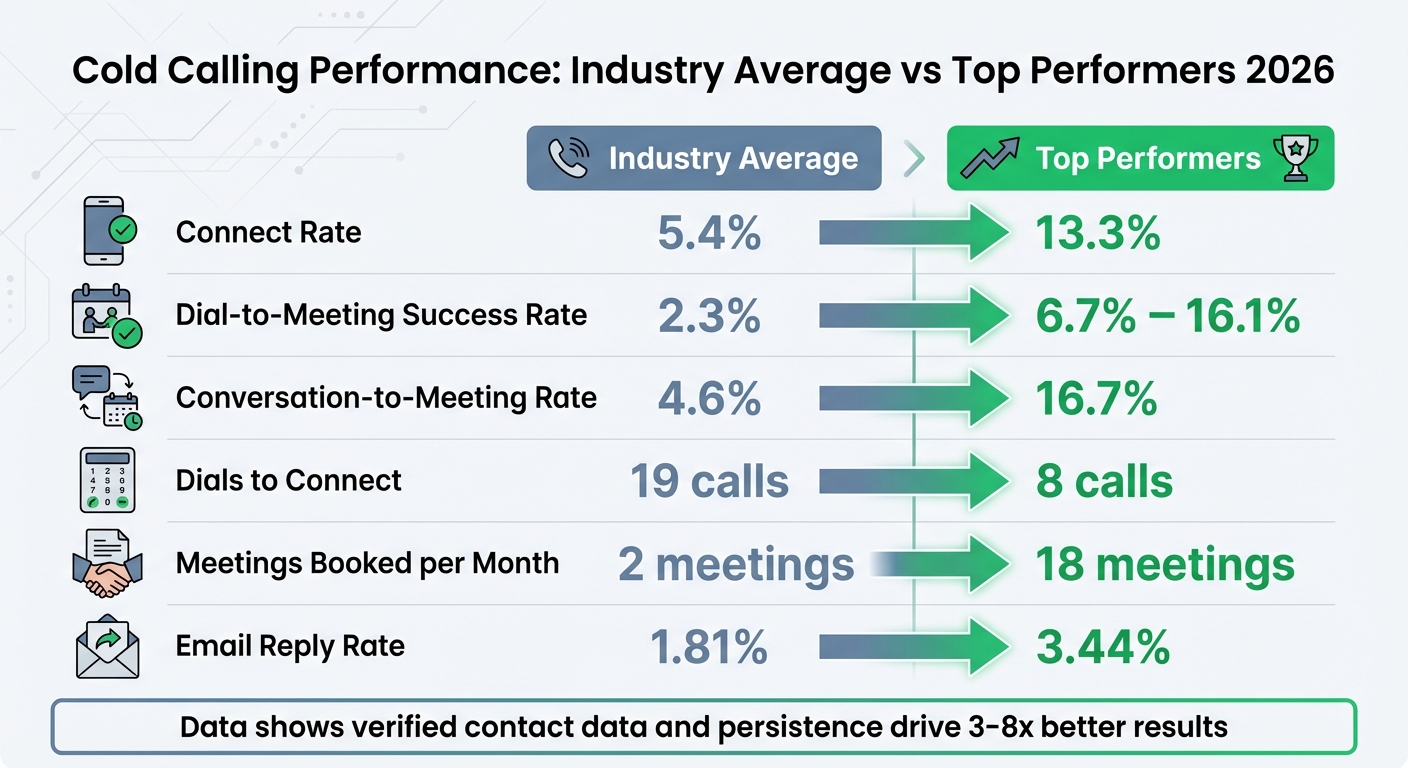
Let’s start with the connect rate - this is the percentage of calls that lead to an actual conversation. On average, reps hit 5.4%, while top performers, using verified data, achieve an impressive 13.3%. Another key metric is the dial-to-meeting success rate, which averages 2.3% but can reach as high as 16.1% for high achievers.
Next, pay attention to the conversation-to-meeting rate - average reps convert at 4.6%, but top performers hit 16.7%. The meeting-held rate is another critical measure, with a strong benchmark hovering around 85.9%. Finally, track the number of attempts per prospect. Research shows that 93% of successful conversations happen by the third call attempt. These metrics highlight how quality data and persistence can transform results.
The difference between average and optimized cold calling results is striking. For instance, average reps book just 2 meetings per month from 800 calls, while top performers secure 18 meetings from the same effort. Verified contact data also reduces the number of dials needed to connect - from 19 to just 8, saving valuable time.
Persistence across multiple channels also pays off. For example, multi-channel outreach nearly doubles email reply rates - from 1.81% to 3.44%. This shows how a well-executed phone strategy can boost engagement across other platforms, creating a ripple effect that amplifies results.
Metric Industry Average Top Performers Connect Rate (%) 5.4% 13.3% Dial-to-Meeting Success Rate (%) 2.3% 6.7% – 16.1% Conversation-to-Meeting Rate (%) 4.6% 16.7% Dials to Connect 19 8 Meetings Booked per Month 2 18 Email Reply Rate (%) 1.81% 3.44%
This table paints a clear picture of what’s possible when high call volumes are paired with smart, data-driven strategies. Companies like Leads at Scale demonstrate how making over 1,000 targeted calls per month - combined with verified prospect lists and multi-touch campaigns - can elevate clients into the top performance tier. This approach not only builds a strong B2B sales pipeline but also provides a clear roadmap for scaling outbound efforts without overwhelming your team.
The numbers don’t lie - cold calling remains a powerful and effective tool in B2B sales. Even in 2026, the phone continues to be the most direct route to decision-makers, with 82% of buyers open to meetings initiated through a cold call. These stats highlight one essential truth: success hinges on execution, making tailored strategies more important than ever.
The gap between mediocre and standout results boils down to how well you execute. It’s about making the right calls, using the right approach, and relying on high-quality data combined with persistence.
"Cold calling evolves into an insight-driven discipline using technology, timing, and precise technique." – Trellus Editorial Team
As earlier statistics confirm, cold calling thrives when supported by accurate data and consistent effort. Companies like Leads at Scale exemplify this by delivering outstanding results through B2B appointment setting services using US-based representatives, verified prospect lists, and over 1,000 targeted calls each month. Their approach ensures a predictable pipeline that surpasses industry benchmarks.
The future of B2B sales belongs to teams that treat cold calling as a precision tool rather than a numbers game. By blending human connection with data-driven targeting, maintaining persistent outreach, and employing strategic follow-up, sales teams can create a reliable lead generation process. Fine-tune your B2B lead generation strategies, leverage the power of data, and stay consistent - this is the formula for long-term growth. As we look ahead, those who adopt this precision-driven mindset will continue to secure high-quality leads well into 2026 and beyond.
AI is reshaping cold calling, making it sharper and more efficient than ever. Picture this: advanced AI platforms can now dig into a prospect's recent online activity - like their website visits or LinkedIn updates - and arm sales reps with tailored talking points. Instead of leaning on tired, generic scripts, reps can kick off calls with relevant and engaging openers that actually resonate. On top of that, AI-driven dialing systems work around the clock, ensuring every lead gets a polished, professional interaction.
But the benefits don’t stop there. AI is also transforming how reps train and prepare. With AI-powered simulators, they can practice responding to objections, fine-tune their tone, and get real-time feedback to sharpen their skills. Predictive AI takes it a step further by identifying high-potential leads, so sales teams can zero in on prospects who are more likely to convert. These advancements don’t just make cold calling smarter - they elevate call quality, save time, and drive better results, proving that this strategy is far from outdated in 2026.
To make your cold calls more impactful in 2026, concentrate on timing, targeting, and thoughtful follow-up strategies:
Consistency is critical - track your performance metrics, adjust your approach as needed, and remain persistent without overwhelming your prospects. By honing these strategies, you can elevate your cold-calling game and achieve stronger results.
Cold calling often gets a bad rap among sales teams. Many see it as outdated and time-intensive, especially compared to digital options like email. The numbers don’t help its case either - it can take an average of eight attempts just to connect with a decision-maker. When you stack that against the ease of sending out bulk emails, it’s easy to understand why some might label it as inefficient.
On top of that, cold calling still carries a reputation for being intrusive or overly generic. This typically happens when calls lack a personal touch or rely on outdated techniques. Adding fuel to the fire are headlines claiming that cold calling is "dead", which only deepen the skepticism. But here’s the thing: cold calling isn’t obsolete. When approached strategically - with personalized outreach, clear targeting, and proper coaching - it remains a powerful way to generate leads and drive revenue.