



Cold Calling Tips: 50 Expert Strategies to Improve Your Success Rate
Cold calling still works — with research, better openers, adaptive scripts, and the right tech, turn cold calls into meetings with 50 proven strategies.




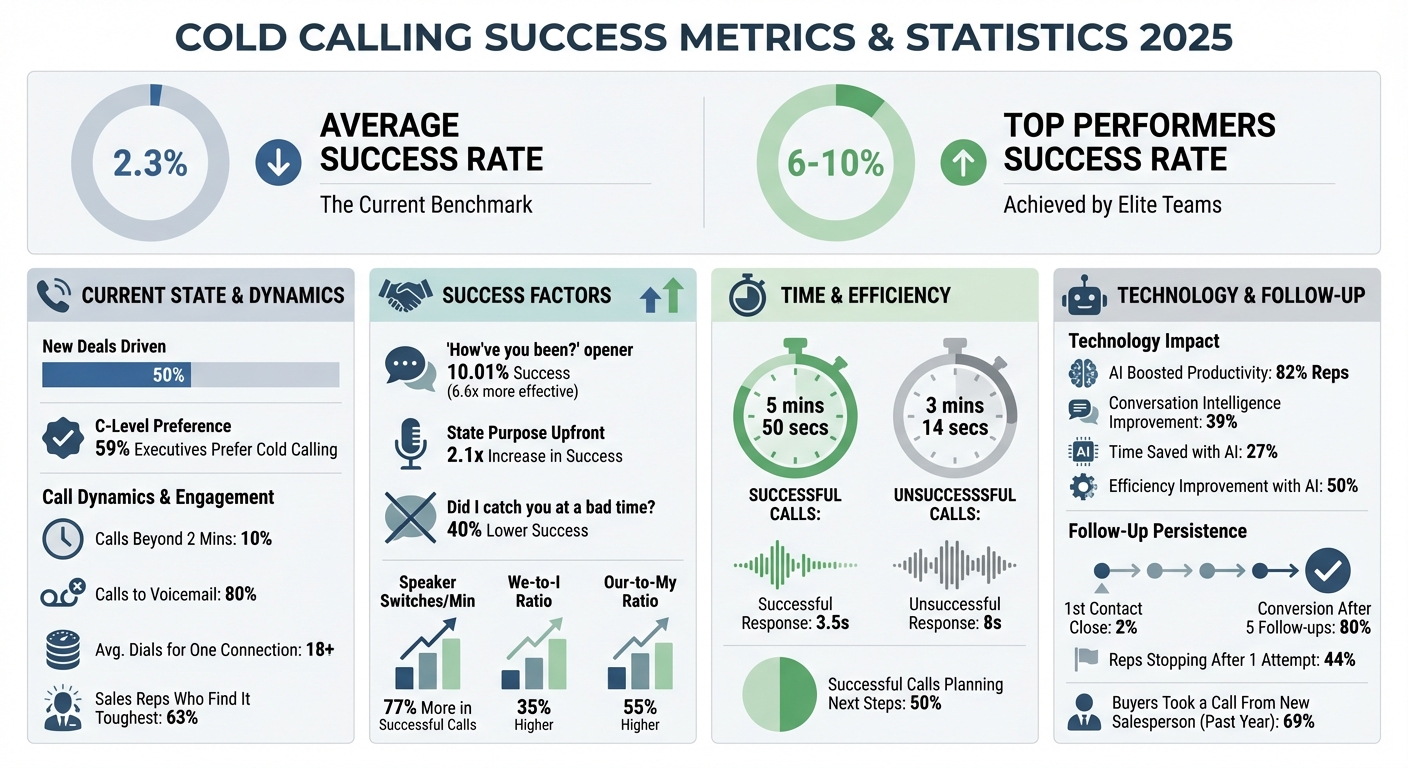
Cold calling isn't dead - it just needs the right approach. Despite a modest 2.3% success rate in 2025, this strategy still drives 50% of new deals and remains a preferred contact method for 59% of C-level executives. The key? Preparation, personalization, and persistence. Top-performing teams achieve 6–10% success rates by focusing on research, engaging openings, and strategic follow-ups.
This guide covers 50 actionable strategies across five areas to help you connect with prospects, book meetings, and improve your outcomes:
Cold calling is tough, but with the right tools and techniques, you can turn it into a productive and rewarding part of your sales strategy.
Laying the groundwork before making a call is essential for connecting with today's well-informed B2B buyers. A little preparation goes a long way in ensuring your outreach is both relevant and impactful.
Before picking up the phone, take a moment to review your CRM. Look for any notes from past interactions, updates from colleagues, or the lead's current status. This avoids redundant conversations and keeps your approach fresh and informed.
Spend just five minutes to gather five key insights about your prospect. Check their latest LinkedIn posts, company press releases, or news about funding rounds. These details can provide a natural and timely reason to reach out.
Get a solid grasp of the company's business model, products, and competitive environment. For publicly traded companies, dive into their SEC filings (like 10-K or 10-Q reports) to understand their financial health. For startups, platforms like Crunchbase or AngelList are great for spotting funding rounds or acquisition history.
Identify not only the obvious decision-makers but also the behind-the-scenes influencers within the organization. As Jonathan Ilett, VP of Global Sales at Cognism, puts it:
"In every deal, there are visible decision-makers and invisible power lines. If you don't map them, you'll end up blindsided by someone you didn't know was part of the process."
Every call should have a specific goal, whether it's booking a demo, identifying the decision-maker, or setting the stage for a follow-up. Focus on advancing the conversation rather than attempting to close the deal on the first call.
Group your prospects by their industry and job title to make your research and messaging more focused. Dan Tyre, a former sales executive at HubSpot, advises:
"The key is to know the segment so well that your description of your company precisely matches the prospects' needs."
Clean up your contact lists by removing invalid numbers and cross-checking against "Do Not Contact" registries. Prioritize mobile numbers over office lines to bypass gatekeepers and improve your chances of connecting. Update your CRM immediately if you encounter disconnected numbers to avoid wasting time in the future.
Look out for changes like new leadership hires, office expansions, or funding announcements that could signal an opportunity. Tools like LinkedIn Sales Navigator can help you stay on top of these events in real time.
Customize your pitch to directly address the prospect's pain points and align them with a specific feature or benefit of your product. Use the same language they use in their LinkedIn profile or company blog to make your message resonate. As Chris Orlob, CEO of Pclub.io, explains:
"Your buyer's words will always resonate more than your words."
Find a quiet space for your call and take a few minutes to calm your nerves - whether through deep breathing or listening to music. Considering that 63% of sales professionals say cold calling is the toughest part of their job, mental preparation can make a big difference. Top sales performers often dedicate about an hour each day to researching their highest-priority targets.
Research Source Key Insights LinkedIn Job history, recent activity, shared connections, and professional tone SEC Website Financial performance, quarterly reports (10-Qs), and annual filings (10-Ks) Crunchbase Funding details, acquisitions, and competitors Company Blog Current challenges, recent wins, and strategic goals CRM Past interactions, email engagement, and personal details
With all this preparation in place, you're ready to focus on creating an engaging opening that builds rapport and sets the tone for a productive conversation.
A strong opening can make or break a cold call. In fact, the first 60 seconds are critical - this brief window determines whether you engage in a meaningful conversation or hear the dreaded dial tone. Since only 10% of calls last beyond two minutes, your opening must cut through initial resistance and spark interest.
Always introduce yourself with both your first and last name, along with your company. This immediately establishes your credibility and shows that you're a professional worth their attention.
Instead of diving into your pitch, start with "How've you been?". This simple question disrupts the prospect's usual defenses, creating a moment of pause. It also implies familiarity, which naturally boosts engagement. Research shows this approach has a 10.01% success rate, making it 6.6 times more effective than standard openings.
Be upfront about why you're calling. People are more likely to respond positively when you provide a clear reason early on. Studies show that stating your purpose increases success rates by 2.1x. This transparency helps ease any initial skepticism.
Acknowledging the nature of a cold call can help build trust. Josh Braun, Founder of Josh Braun Sales Training, suggests this opener:
"Hi (first name), you're probably going to hate me because this is a cold call. Would you like to hang up or roll the dice?"
This playful approach shifts the dynamic, giving prospects a sense of control while encouraging curiosity.
Instead of asking basic questions, verify the information you've researched. For example, say, "I see your company has 500 employees; is that right?". This demonstrates preparation and professionalism, avoiding the impression that you're unprepared.
Replace "I" and "my" with words like "we", "us", and "our." Successful cold calls tend to have a 35% higher "We-to-I" ratio. This subtle shift makes you sound like a partner rather than just someone pushing a product.
Pay attention to how the prospect speaks and adapt accordingly. If they’re quick and to the point, follow suit. If they’re more relaxed, slow your pace to match. Mirroring their communication style helps build a natural connection.
Using the word "imagine" helps prospects picture how your solution could improve their situation. For instance, you might say, "Imagine if your team could cut lead research time in half." This creates an emotional connection and makes your offer more tangible.
Gently point out inefficiencies or challenges they might be facing. For example, you could say, "Your team is still searching for every lead manually?". This approach, known as "poking the bear", helps prospects recognize the hidden costs of their current methods.
This question gives prospects an easy way to end the call. In fact, it makes you 40% less likely to secure a meeting. Instead, ask for a small time commitment, like "Do you have 30 seconds for me to explain why I’m calling?" This keeps you in control while respecting their time.
Opening Phrase Success Rate Impact Why It Works "How've you been?" 10.01% (6.6x higher) Disrupts autopilot defenses with familiarity "The reason for my call is..." 2.1x higher success Immediately answers "Why me?" "How are you?" 3.4x higher success Builds rapport through polite small talk "Did I catch you at a bad time?" 40% lower success Makes it too easy for them to disengage
Once you've established rapport, the next step is executing a script that feels natural yet effective. Think of your script as a guiding framework - not a rigid speech. It should adapt to the twists and turns of the conversation, especially when prospects bring up concerns about price, timing, or relevance.
Forget about memorizing a script word for word. Talk tracks provide structure while leaving room for personalization. Picture them as a flexible roadmap that adjusts to the prospect's input. This approach keeps your tone conversational and responsive, rather than robotic.
Your main goal during a cold call isn’t to close a deal - it’s to secure a follow-up meeting. Save deep discovery questions or product pitches for later. Instead, focus on showing just enough value to make the next conversation worthwhile.
When explaining what you do, keep it short and specific. A 10- to 30-second positioning statement should directly tie your value to the prospect's needs or challenges. For example: “We help sales teams cut lead research time in half so they can spend more time talking to prospects.”
The best cold calls have 77% more speaker switches per minute compared to less successful ones. Keep the conversation dynamic by asking short questions and allowing space for the prospect to respond. This back-and-forth flow keeps them engaged.
When a prospect raises objections, start by acknowledging their concerns. Using phrases like "I understand where you're coming from" can help lower their defenses before steering the conversation back to your value. This approach shows you're actively listening, not just waiting for your turn to speak.
Words like "um", "actually", and "just" can dilute your message. Eliminating these filler words makes you sound more confident and professional. Practice speaking out loud to refine your delivery.
Ask, "Do you have your calendar handy?" to lock in a follow-up appointment.
Maintain a live document that records common objections and the responses that worked best. Over time, this becomes a valuable resource for your team, helping everyone handle pushback more effectively.
After delivering a key statement or asking a question, pause for a few seconds. This silence encourages the prospect to fill the gap, fostering deeper engagement.
In successful cold calls, prospects typically respond with 3.5-second answers, compared to 8-second responses in less effective calls. Craft your questions to elicit concise, meaningful replies rather than lengthy explanations.
With these execution and scripting techniques in place, you're ready to integrate technology to streamline your process even further.
The right technology can turn cold calling from a simple numbers game into a precise and effective strategy. By leveraging AI-powered tools, sales teams can reduce manual tasks, focus on high-priority prospects, and spend more time engaging in meaningful conversations. In fact, 82% of sales professionals report that AI has boosted their productivity. Plus, using conversation intelligence tools has been shown to improve cold calling success rates by 39%.
AI tools like Clay can scan LinkedIn profiles, company websites, and even recent news to create personalized conversation openers. This transforms generic cold calls into "warm calls" by using specific, timely triggers - such as a company’s latest funding round or a recent hire - to make your outreach feel more relevant.
Access to accurate contact information is key. Platforms like Cognism, Apollo.io (starting at $49/user/month), and Seamless.ai provide direct-dial numbers and intent signals, helping you connect with decision-makers on the first try. Research shows that calling a prospect’s cell phone significantly increases connection rates compared to reaching out to office desk lines. Apollo.io, for instance, boasts a 4.7/5 rating on G2 and even offers a free plan for teams just getting started.
Manual dialing can eat up a lot of valuable time. Automated dialers like Orum address this by dialing the next number - or even multiple numbers - automatically. Considering it often takes over 18 dials to connect with a single prospect, these tools can dramatically increase the number of live conversations you have in a day.
Platforms like Gong (starting at $5,000/year base fee plus ~$1,500/user/year) and Salesforce Einstein Conversation Insights analyze call recordings to uncover patterns that contribute to success. These tools can detect buyer sentiment, highlight common objections, and offer actionable coaching opportunities. Gong, for example, holds a 4.8/5 rating on G2.
Cold calling works best when it’s part of a broader outreach strategy. Tools like Outreach and Reply.io allow you to manage sequences that combine calls with follow-up emails and LinkedIn messages. This multi-channel approach ensures your message reaches prospects in different formats, increasing the chances they’ll engage with you.
Crystal uses AI to analyze DISC personality profiles, predicting a prospect’s preferred communication style. For example, if someone values direct, results-driven conversations, you can adjust your approach to match their preferences before making the call.
Since 80% of cold calls end up in voicemail, using voicemail drop technology can save hours. This tool allows you to leave polished, personalized messages with just one click.
"Reps always ask me whether they should leave voicemails anymore since they almost never get a callback. My response is yes - as long as they are good ones."
Integrating your calling tools with a CRM like Salesforce, monday CRM (starting at $12/seat/month), or HubSpot ensures that calls are logged, transcribed, and updated automatically. This eliminates the need for manual data entry and ensures no leads fall through the cracks. Some CRMs even use AI to summarize calls and capture key details like prospect sentiment.
Spam flags on your sales number can hurt your connection rates. Using tools to monitor your number’s status and rotating it when needed can help maintain your ability to reach prospects effectively.
Key metrics like connect rate (the percentage of calls that reach a live person), meeting-booked rate, and speaker switches per minute can provide valuable insights. For instance, successful cold calls feature 77% more speaker switches than unsuccessful ones, showing a shift from a one-sided pitch to an engaging conversation. Conversation intelligence platforms can track these metrics automatically, giving you a clear view of what’s working.
Next, we’ll explore how to build on these efficiencies to close deals during follow-up conversations.
Once your script and tech are fine-tuned, the next step is all about keeping the momentum going. The goal? Secure micro-commitments that push the conversation forward. In fact, successful cold calls dedicate about 50% of the discussion to planning next steps. This approach turns what could be a dead-end into an opportunity - like setting up a meeting or agreeing on an action.
Instead of trying to close the deal on the spot, focus on booking a follow-up, like a discovery call or a demo. Tie a specific feature to a pain point the prospect mentioned earlier, and use that connection to suggest the next step.
"The objective of a cold call is not to make a sale, but to move the prospect on to the next stage of your sales process."
When it’s time to schedule the meeting, ask, "Do you have your calendar handy?". This simple question encourages immediate action.
When discussing next steps, use collaborative language like "we" and "our." This positions you as a partner rather than just a salesperson. Research shows that successful cold calls have a 35% higher "We-to-I" ratio and a 55% higher "Our-to-My" ratio compared to unsuccessful ones.
Time management is critical to maintaining momentum. Keep your pitch concise so there’s enough time to calmly discuss next steps and address any lingering questions.
"Reps who consistently struggle with converting deals to the next stage simply run out of time at the end of the call."
Before ending the call, summarize the agreed-upon next steps aloud and send a calendar invite right away. This solidifies the commitment while it’s fresh in their mind.
Send a follow-up email later that day or within 24 hours. Include something valuable, like a relevant case study, an industry report, or a podcast episode that addresses their challenges. This keeps you on their radar and shows you’re genuinely invested in solving their problems.
Prepare for various scenarios by mapping out 3–4 potential next steps before the call. If the prospect shows interest, suggest a demo. If they’re hesitant, offer a case study or additional resources. Having a plan ensures you can adapt smoothly, no matter how the conversation unfolds.
After the call, immediately update your CRM with detailed notes. Record the prospect’s pain points, decision-making factors (like budget or timing), and the exact follow-up schedule. This ensures continuity if a colleague needs to step in and helps you tailor future outreach.
If the prospect mentions someone else who might be a better fit, ask for permission to reference their name. For example, saying, "Sarah from your team suggested I connect with you," can instantly make your outreach more credible.
Here’s a surprising stat: only 2% of sales close on the first contact, but the conversion rate can jump to 80% after five follow-ups. Yet, 44% of sales reps stop after just one attempt. Persistence is key. Space your follow-ups over days or weeks, and always include fresh, relevant insights to keep the prospect engaged.
Cold calling requires preparation, execution, and, most importantly, persistence. The 50 strategies we've discussed all emphasize one key takeaway: success begins long before you make the call. Doing your homework and tailoring your approach can make all the difference. And when you do pick up the phone, those first few seconds are absolutely crucial.
Focus your efforts on selling the meeting, not the product. Use inclusive language like "we" and "our" to position yourself as a partner, not just a salesperson. Research shows that successful calls feature a 35% higher "We-to-I" ratio and tend to last longer - averaging 5 minutes and 50 seconds compared to the 3 minutes and 14 seconds of less effective calls. This extra time allows you to ask thoughtful questions, listen carefully, and collaborate on the next steps. These people-first strategies create a solid foundation for integrating tech-driven solutions.
Speaking of technology, leveraging the right tools can take your efforts to the next level. AI-powered platforms can save up to 27% of your time and improve efficiency by 50%. Tools like power dialers, voicemail drops, and conversation intelligence software free you up to focus on what really matters: building meaningful connections. Pairing these tools with a structured follow-up plan ensures you're maximizing every opportunity.
The numbers speak for themselves: 69% of buyers took a call from a new salesperson in the past year. Buyers are open to hearing from you - as long as you approach them the right way. So, put these strategies into action. Experiment with different openers, refine your scripts, and make the most of your CRM. Each call is a chance to improve and get closer to your goals.
"Successful people do what unsuccessful people are not willing to do. Don't wish it were easier, wish you were better."
AI tools are changing the game for cold calling, making the process faster and more tailored. These tools can whip up personalized scripts in seconds, adjusting opening lines, value propositions, and even how to handle objections based on details like the prospect’s role, industry, or recent activity. This means sales reps can spend more time connecting with prospects and less time preparing, all while delivering messages that truly resonate.
During calls, AI steps in with real-time insights by analyzing things like tone, pace, and key phrases. It can even suggest tweaks on the spot - like highlighting a benefit more strongly or steering clear of certain language. And the help doesn’t stop there. After the call, AI-powered feedback breaks down what worked and what didn’t, offering actionable advice to fine-tune the next conversation. The result? Higher connection rates, shorter sales cycles, and a better chance of turning cold calls into productive discussions.
Handling objections during a cold call takes a mix of patience, understanding, and a clear game plan. Start by really listening to what the prospect is saying - don’t jump in or try to cut them off. Show them you’re paying attention with responses like, “I get what you’re saying,” or “That makes sense.” This shows respect and sets the tone for a constructive conversation.
Next, dig deeper into their concern by asking open-ended questions. For instance, if they mention timing, you could ask, “Can you tell me more about why this isn’t the right time?” This helps you uncover the real issue behind their hesitation, which might be different from what they first mention.
Once you understand their concern, offer a solution that speaks directly to their needs. Let’s say they bring up budget limitations. You could respond with something like, “I completely understand budget concerns - what if I showed you how this could save you $5,000 a year?” By focusing on their pain points and offering a clear benefit, you keep the conversation productive and collaborative.
A helpful approach to handling objections is the Validate-Clarify-Respond framework:
Keep your tone friendly and focused on helping them solve their problem. This approach can transform objections into opportunities to keep the conversation moving in a positive direction.
Following up plays a key role in improving your cold calling results. Most prospects require several interactions before they're ready to take the next step, and a carefully timed, considerate follow-up can be the tipping point.
It demonstrates your determination, professionalism, and sincere commitment to addressing their needs. By keeping yourself visible in a respectful way, you build trust and improve your odds of turning the conversation into a successful deal.