



B2B Sales Pitch Templates
Practical, customizable B2B sales pitch templates for cold emails, calls, follow-ups, ROI slides, videos and objection handling.



In B2B sales, first impressions are critical - buyers often decide within seven seconds whether your pitch is worth their time. The challenge? Most reps fail to address specific customer needs, with 59% of buyers feeling misunderstood. This guide offers practical, customizable templates to help you craft pitches that resonate across common scenarios like cold emails, phone calls, and follow-ups. Key takeaways include:
These templates save time, improve personalization, and help you address specific buyer challenges. By focusing on clarity and relevance, you can boost engagement, close rates, and revenue.
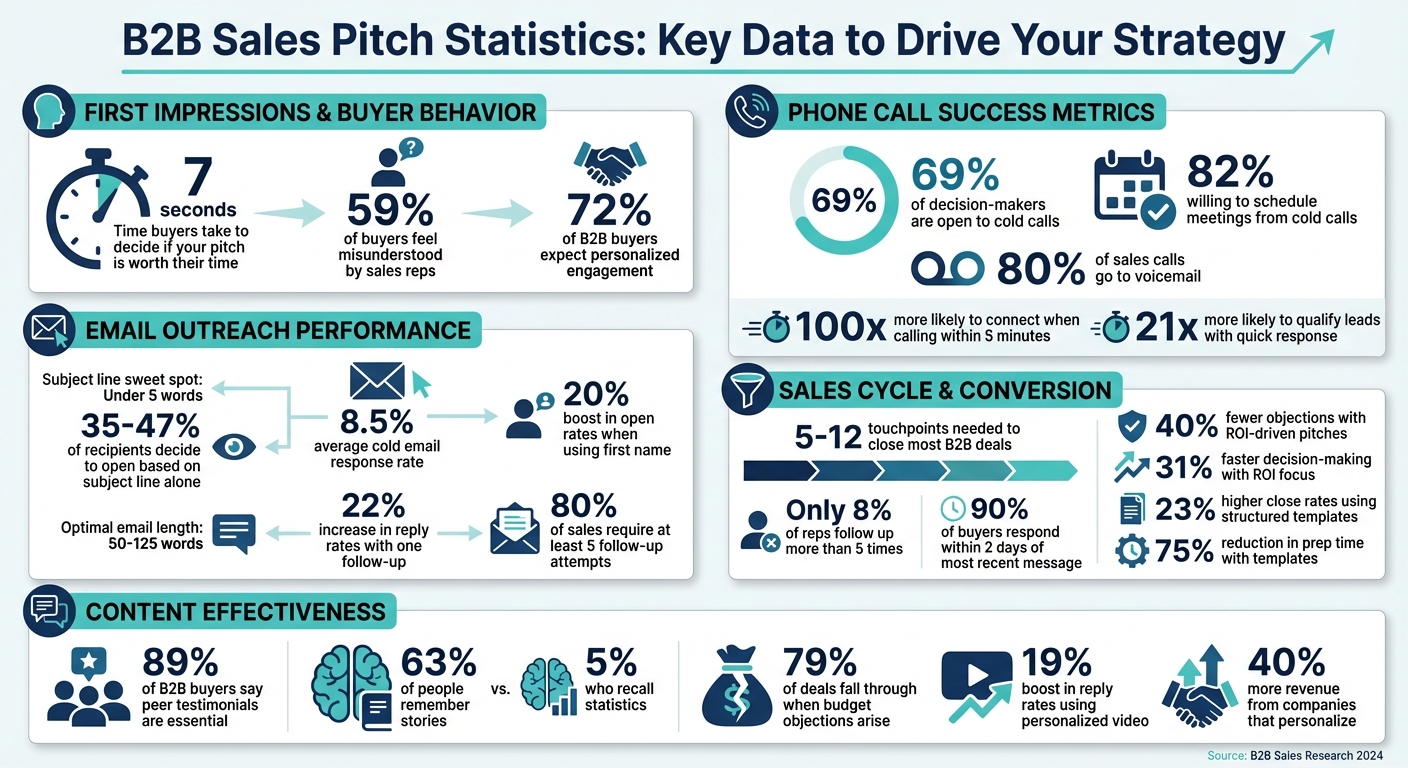
Cold email outreach remains a go-to strategy in the B2B world. While the average response rate sits at 8.5%, the gap between a generic mass email and a tailored, thoughtful message is enormous. In fact, a well-constructed email template once achieved a 57% open rate and 21% response rate, landing 16 new customers for a SaaS company. The secret? A simple, flexible structure built on one or two research-driven sentences.
Start with a subject line under five words that directly addresses the prospect's specific challenge. Why? Because 35% to 47% of recipients decide whether to open an email based solely on the subject line. Adding their first name can also boost open rates by 20%. Once they open the email, your first sentence should focus on them - highlighting a recent win or addressing a pressing pain point. Keep the email concise, ideally between 50 and 125 words, and write at a third-grade reading level to ensure it’s easy to skim on mobile devices.
Your value proposition needs to be specific and measurable. Don’t just say, "We help improve sales." Instead, say, "We help B2B SaaS companies cut their sales cycle from 90 to 45 days." Back it up with social proof - use concrete examples like, "Company X tripled their monthly revenue in six months." Finally, close with an interest-based call-to-action rather than an overly formal time request. A simple "Worth a chat?" is twice as effective as asking for a 15-minute meeting.
"B2B email templates should be used as a starting point... but there's a balance to be struck between sending an entirely templated cold email outreach campaign (never a good idea) and 100% personalized emails." - Sujan Patel, Founder, Mailshake
To refine your outreach even further, dive into targeted research. Use the 3x3 method: spend three minutes finding three specific details about each prospect. Mention a trigger event - like a recent funding round or a LinkedIn post - to make your email immediately relevant. And don’t forget to follow up. A single follow-up can boost reply rates by 22%, and 80% of sales require at least five follow-up attempts.
Phone calls, like email outreach, work best when they feel personal and relevant. Here's an interesting stat: 69% of decision-makers are open to receiving cold calls, and 82% are willing to schedule meetings. The challenge? Getting past the reflexive "hang up" response. Steli Efti, CEO of Close, shared a simple yet effective script that his previous company, ElasticSales, used to land seven paying customers in just two weeks. The focus was on finding the right fit, not pushing a hard sell:
"Hi, my name is Steli Efti. I'm calling some startups in the area to find out if they're a good fit for our beta program. What we do, in a sentence, is we provide companies with a sales team on demand. Does this sound generally interesting to you?"
The magic of this script lies in the 8-second pause. After introducing yourself, stop talking for eight seconds. This unexpected pause breaks the typical telemarketer flow and grabs attention. Then, follow up with a negative question like, "Is it a bad time?" This phrasing makes it more likely they'll respond with "no", keeping the conversation alive.
Timing is another critical factor. If you call a lead within five minutes of their inbound action, you're 100 times more likely to connect with them compared to waiting 30 minutes. Plus, you’re 21 times more likely to qualify that lead. Of course, persistence is key, especially since 80% of sales calls go to voicemail.
"In a cold call, assume you're interrupting prospects on a busy day. Get to the point. Prove you value their time."
– Steli Efti, CEO, Close
To make your calls even more effective, preparation is everything. One helpful tactic is the 3x3 rule: spend three minutes gathering three key insights from LinkedIn. Instead of rattling off product features, use a positioning statement that zeroes in on their pain points. For example: "I work with VP-level sales leaders at mid-market SaaS companies who are struggling to scale their outbound without hiring more reps." This shifts the focus to their challenges, making the conversation about them, not just your product.
With the right mix of timing, research, and strategy, what starts as an interruption can quickly turn into an opportunity.
An elevator pitch is your chance to spark interest in just 30–45 seconds, or about 75–100 words. In New York City, the average elevator ride is only 21 seconds, so every word has to pull its weight. The goal? Not to seal the deal right then and there, but to generate enough curiosity for a follow-up conversation. This framework is designed to help sharpen your B2B sales communication.
Start with a hook that grabs attention. It could be a bold question, a relatable problem, or an intriguing insight. For example: “What if you could cut your follow-up time in half without hiring more reps?” This shifts the focus from product features to solving a real pain point.
Next, zero in on their specific challenge. A CMO might wrestle with brand visibility, while a VP of Sales might lose sleep over B2B sales pipeline quality. Tailor your pitch to their role and industry. Once you’ve identified the problem, present your solution clearly and concisely. Skip the feature list - focus on outcomes. Will your solution save time, boost revenue, or cut costs?
Wrap it up with a strong call to action, like “Can we schedule a 15-minute call next week?” This is the first step toward B2B appointment setting success. Practice until it feels natural. As Daniel Pink aptly puts it:
"One of the most effective ways of moving others is to uncover challenges they may not know they have".
Here’s a real-world example: In 2010, Hipmunk CEO Adam Goldstein sent a two-sentence pitch to the CEO of United Airlines. It highlighted how Hipmunk could help customers find flights faster. The response? The CEO replied within 15 minutes. That pitch helped Hipmunk secure over $55 million in funding. It’s proof that a well-crafted elevator pitch can open doors you didn’t even know existed.
Sales reps often give up too soon - only 8% follow up more than five times, even though most B2B deals take 5–12 touchpoints to close. This gap is where opportunity lies. The trick? Make every follow-up meaningful by offering fresh value instead of just "checking in."
Start by referencing specifics from your last interaction. Mention their pain points, agreed-upon action items, or timelines they’ve shared. This not only shows you were paying attention but also keeps the conversation moving forward. Within 24 hours of a demo or call, send a recap email summarizing key points and suggesting a clear next step. A structured follow-up schedule signals your commitment to their needs.
Want to stand out? Remember this: 90% of buyers respond within two days of the most recent message. If you don’t hear back, stick to a structured plan - follow up on Day 3, again on Day 7, and send a final "break-up" email on Day 21. Each message should deliver something new: a relevant case study, an industry trend, or a resource that tackles their specific challenge.
Keep your follow-ups short - between 50 and 125 words - and include just one clear call to action. For example, propose a specific time for a quick 15-minute call. The goal isn’t to pressure them but to stay on their radar and make the next step as easy as possible.
Persistence works, but only when it’s paired with personalization and genuine value.
When it comes to decision-making, outcomes trump features every time. That’s why leading with ROI (Return on Investment) is so effective. In fact, sales teams using ROI-driven templates experience 40% fewer objections and 31% faster decision-making cycles. The key? Structuring your pitch around three straightforward elements: what the investment entails, the benefits they’ll gain, and how quickly those benefits will materialize.
To apply this strategy, use the Investment-Return-Payback framework across 3–4 slides or email sections. Start by clearly outlining the initial investment - be upfront about costs to build trust. Then, highlight the expected returns, complete with specific timelines. For instance, if your solution saves 10 hours per week, break it down into financial terms: 10 hours × $50/hour × 52 weeks = $26,000 in annual savings. Finally, wrap it up with the payback period and a projection of long-term value.
Credibility is crucial. Offer multiple scenarios - best case, realistic, and conservative. Always cite your sources and lean on conservative estimates so prospects can independently verify your calculations. Focus on metrics that resonate with financial decision-makers, such as Net Present Value (NPV), Internal Rate of Return (IRR), and the payback period. These metrics align with how CFOs assess investments and add weight to your pitch. Once the numbers are solid, you can elevate the presentation with compelling storytelling.
Storytelling makes all the difference. Research shows that 63% of people remember stories, while only 5% recall individual statistics. Use this to your advantage by framing your ROI data within a narrative. Share examples of companies that have used your solution to drive measurable success. For instance, illustrate how a similar business reduced manual workloads or hit critical quarterly goals. Tie operational improvements to personal wins for the buyer, making the benefits feel tangible and relatable.
Take it a step further by incorporating interactive tools into your pitch. Create an ROI calculator that allows prospects to input their own data and see personalized results. This not only engages them but also gives them a sense of ownership over the numbers. Use visuals like bar charts to showcase payback periods or line graphs to highlight cumulative savings over time. Turning abstract financial data into something visual and concrete makes it easier for prospects to grasp the value - and act on it.
Nothing wins trust faster than showing a prospect how someone in their shoes tackled the same challenge they're facing. In fact, 89% of B2B buyers say peer testimonials are essential when researching solutions. The trick? Build your success story around a clear, relatable narrative. Contrast the "Before" - where pain points and frustrations took center stage - with the "After", where measurable wins and improvements shine through. This storytelling style fits perfectly with ROI-focused and follow-up strategies, adding a layer of relatable, real-world proof.
To amplify the impact, frame your customer's journey as a fight against inefficiencies. Identify the "villain" - but don’t point fingers at competitors. Instead, highlight obstacles like outdated processes, clunky legacy systems, or time-draining manual workflows. Then, position your customer as the hero who overcame these challenges using your solution. This approach works because it’s about their transformation, not a laundry list of product features.
Keep the story short and snappy - something your prospect can summarize in a sentence or two. Back it up with specific results, like "cut training costs by 50%" or "saved 5 hours a week", to make the change feel real and concrete.
Make sure the narrative speaks directly to your B2B buyer personas. A CFO, for example, will care about ROI and payback periods, while an Engineering Manager might zero in on efficiency and time savings. Use role-specific testimonials and relevant benchmarks to show you understand their world. And don’t forget the visuals - include screenshots, charts, or slides with bold, easy-to-read numbers that highlight the transformation. Like the other templates, customizing your customer success story ensures it hits home with your audience.
handling objections effectively can turn hesitations into opportunities. When a prospect raises concerns, think of it as a sign of interest rather than a dealbreaker. In fact, 79% of deals fall through when budget objections arise during sales calls. But here's the thing: most objections aren't the real issue - they often mask deeper concerns. A clear, structured approach - acknowledge, pause, clarify, reframe, and validate - can help uncover and address the root of the objection. This method works because it shifts the focus from resistance to understanding.
Start by digging deeper to isolate the true concern. For instance, if a prospect mentions cost, you might ask: "Putting price aside for a moment, what are your thoughts on the product?". This helps determine whether budget is the real obstacle or just a surface-level excuse. Often, objections fall into categories like Budget, Authority, Need, or Timing (the BANT framework), and each requires a specific approach. For budget concerns, steer the conversation toward the return on investment. If timing is the issue, emphasize the potential costs of waiting. And when they say, "I need to check with my boss," dig deeper by asking what information their boss would need to approve the decision. You could even offer to join their internal discussion.
"Prioritize listening with empathy and pay more attention to signals that provide insight into customer interest, intentions, and context." – Laura Ramos, VP, Principal Analyst, Forrester
Avoid the temptation to immediately offer discounts. Instead, suggest removing nonessential features to better align the cost with their budget. This approach protects your margins while showing flexibility. At the end of the conversation, ask a simple but powerful question: "Is there anything else?". This often uncovers any lingering concerns that could derail the deal later.
If you’ve addressed all objections and the prospect still hesitates, it might indicate a deeper misalignment. In that case, it’s better to move on and focus your efforts on leads with stronger potential. By following this framework, every objection becomes a chance to drive the conversation forward.
Video prospecting takes personalized outreach to the next level by adding a face-to-face element that feels genuine and engaging. Unlike traditional email or phone tactics, video messages create a more personal connection and stand out in crowded inboxes. In fact, in 2024, Intercom swapped cold outreach for personalized video messages and saw a 19% boost in reply rates, bringing in $120,000 in revenue.
For this to work effectively, both the format and content of your video need to hit the mark. A picture-in-picture layout is a great choice - it allows you to combine your webcam feed with a screen share. Use this to display the prospect’s LinkedIn profile, their company website, or even a specific challenge you’ve identified. This approach not only builds trust but also shows you’ve done your homework. Keep the video short - 90 seconds or less - and start strong by addressing a specific pain point you’ve uncovered through research. Avoid generic introductions; the goal is to show you understand their unique needs right from the start.
"One of the most effective ways of moving others is to uncover challenges they may not know they have." – Daniel Pink, Author
When using screen share, focus on delivering a micro-demo that highlights one key feature of your product or service. The trick is to zero in on something that directly solves the prospect’s problem - don’t overwhelm them with a full product tour. Wrap things up with a clear call to action, like embedding a calendar link for easy scheduling. To maximize your timing, use video platforms that notify you when the message is viewed, so you can follow up while your pitch is still fresh in their mind.
This method fits seamlessly into a larger strategy of personalized outreach across multiple outbound sales channels, giving your efforts a consistent and tailored edge.
Your presentation deck has one job: grab attention within the first 30 seconds. To do this, it needs to be visually clean, focused on outcomes, and easy to adjust for different audiences.
Start strong by including a "Money Slide" early in your deck. This slide should clearly showcase the measurable ROI your solution delivers. Use bold, attention-grabbing numbers to highlight benefits like time saved, revenue generated, or risks reduced. For example, Microsoft’s Office 365 sales deck in 2015 featured a results slide on Slide 10 that stood out with giant red numerals. It highlighted outcomes like 5 hours saved per week, a $200,000 reduction in fuel and labor costs, 0% migration downtime, a 90% drop in spam, a 10% revenue lift, and 40% productivity gains. This kind of slide is perfect for sharing with decision-makers and sets the tone for the rest of your pitch.
Keep the deck concise - 10 to 15 slides is ideal for a 30-minute presentation. Structure your narrative in a way that flows naturally: start with the Problem, move to the Solution, include Case Studies, and finish with a clear call to action. Visuals are key here. Use side-by-side comparisons like screenshots or infographics to show the "before" and "after" states, emphasizing how your product transforms the current situation.
To make your pitch resonate, tailor the content to your audience. B2B buying groups often involve 6–10 stakeholders, each with different priorities. Use modular sections to address these concerns. For instance, if you’re speaking to a CFO, focus on ROI and cost savings. For an IT director, highlight security features and integration capabilities. Companies that personalize their presentations in this way see 40% more revenue compared to their competitors.
Finally, wrap up your deck with an FAQ slide. This is your chance to address common objections concisely and leave your audience with no lingering doubts.
Don’t think of customization as just filling in blanks on a template. Here's a startling fact: 59% of business buyers say most sales reps fail to understand their unique challenges. That’s a huge missed opportunity.
To truly personalize your approach, you need to dig deeper. Go beyond surface-level details like company size. Instead, focus on uncovering industry trends, recent developments, and role-specific priorities. These are the building blocks of meaningful customization.
Start by exploring industry challenges and company-specific triggers. Check out press releases, LinkedIn updates, or recent product launches. Tailor your pitch to the person you’re speaking with. For example:
This role-specific strategy works. Companies that grow faster generate 40% more revenue from personalization compared to their slower-growing peers.
Once you’ve gathered insights, speak their language. Use industry-specific terms to show you understand their world. For instance, if you’re pitching to a healthcare organization, reference compliance challenges like HIPAA or value-based care models. This positions you as a trusted advisor - a role 84% of business buyers expect from sales reps, even though many don’t deliver.
When you start your pitch, lead with the question, “Why Change?” Address their pain points and the risks of doing nothing - whether that’s lost revenue, wasted time, or stalled growth. Save your company’s credentials for later, after you’ve proven your relevance.
By following these tips, you can turn generic pitches into tailored, impactful conversations. As Daniel Pink, author of To Sell Is Human, explains:
"One of the most effective ways of moving others is to uncover challenges they may not know they have".
The templates shared here provide a strong starting point for tackling a variety of B2B sales scenarios - whether you're crafting cold emails, creating video pitches, or addressing objections. But keep in mind, these templates are just that: starting points. The real magic happens when you adapt and personalize them.
Here’s why they matter: structured templates can boost close rates by 23% compared to building pitches from scratch. On top of that, they can cut your prep time by up to 75%. That extra time can be redirected to what truly makes a difference - personalized research and meaningful engagement. And let’s not forget, 72% of B2B buyers expect engagement tailored to their specific needs, yet 59% believe most sales reps fail to understand their unique challenges.
So, how do you make these templates work for you? Choose one that fits your current sales situation and tweak it based on the recipient’s role, industry, and timing. For instance, a CMO will likely care about brand visibility, while a VP of Sales is more focused on pipeline health. SaaS buyers want quick time-to-value, whereas manufacturing buyers are all about improving operational efficiency. Timing matters too - align your outreach with their product launches or market expansions. Use the research strategies we discussed earlier to uncover their specific challenges before you make contact.
To make a cold email pitch stand out, focus on tailoring your message to fit the recipient’s specific needs and situation. Start by doing your homework - dig into the company and the individual you're contacting. Use what you find to craft a personalized opening. This could mean mentioning a recent milestone they’ve achieved, a challenge their industry is currently navigating, or something unique about their business.
From there, connect the dots. Explain how what you’re offering directly addresses their challenges or supports their goals. Keep your tone professional but approachable, and make sure your call-to-action (CTA) is crystal clear, easy to act on, and relevant to the conversation. A well-personalized email not only shows effort but also increases the chances of catching their attention and sparking a reply.
Improving your follow-up sales pitches hinges on personalization. Focus on crafting messages that directly address the prospect's unique challenges and priorities. When your pitch feels tailored, it not only grabs attention but also demonstrates that you’ve put in the effort to understand their needs. Timing matters too - prospects are more likely to engage when they’re deeper into their buying journey. Align your follow-up with their decision-making stage to maximize impact.
To refine your approach, practice consistently and leverage data-driven insights to anticipate possible objections and adjust your message accordingly. Use compelling storytelling, relatable examples, and clear ROI data to make your pitch stand out and build credibility. By combining consistent, well-timed communication with continuous improvement based on feedback, you can significantly enhance your chances of closing the deal.
Focusing on ROI (Return on Investment) during B2B sales pitches is crucial because it emphasizes the tangible benefits your solution offers. Businesses are primarily interested in how your product or service can address their challenges while delivering financial gains - whether that means boosting revenue, cutting costs, or streamlining operations.
When you frame your pitch around ROI, it becomes more compelling and trustworthy. Decision-makers appreciate seeing a clear connection between your offering and their bottom line, which not only strengthens your credibility but also helps them feel confident in justifying the investment.