



SaaS Lead Generation: Complete Appointment Setting Guide [2026]
B2B SaaS appointment setting: define ICP, build targeted lists, use multi-channel outreach, qualify leads, and scale with AI.



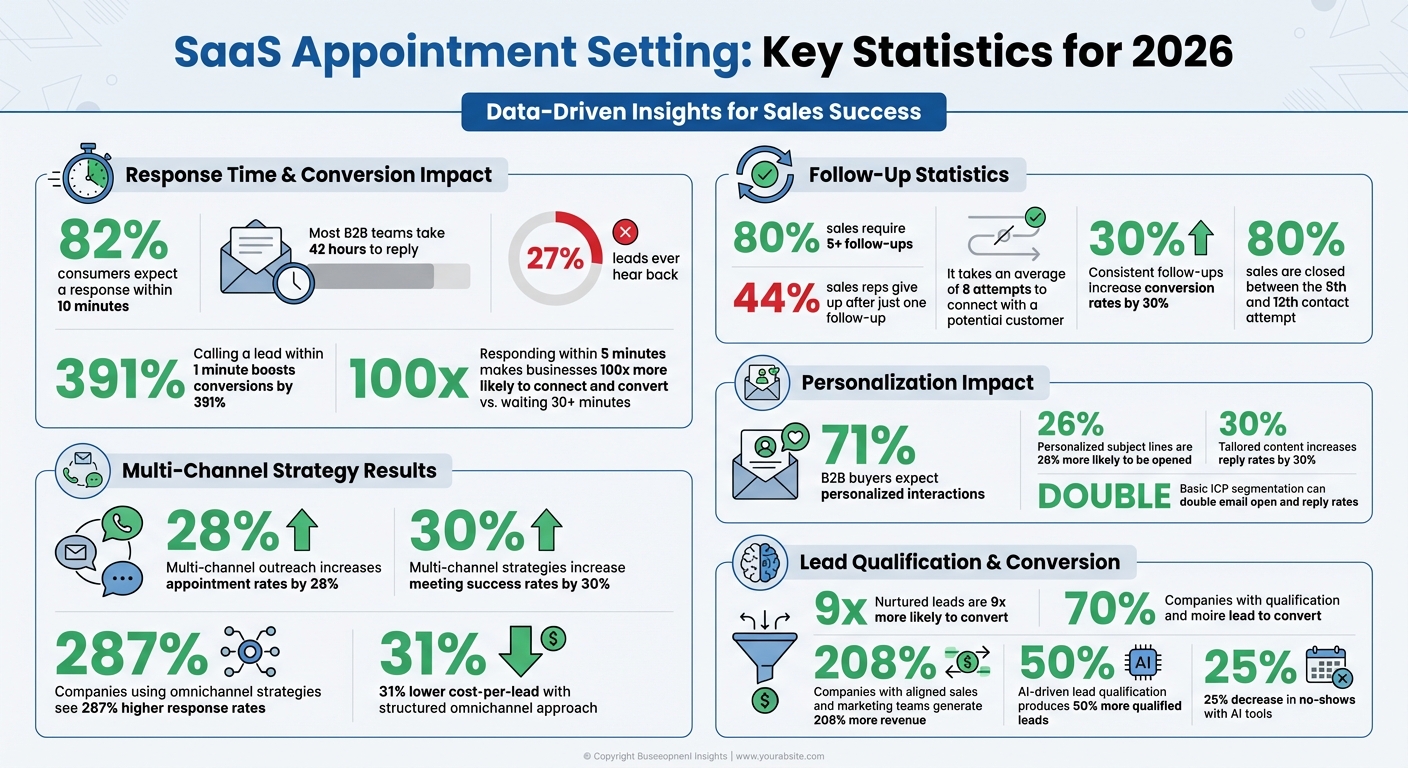
Struggling to turn leads into meetings? Here's the reality: 82% of consumers expect a response within 10 minutes, but most B2B sales teams take 42 hours to reply. Worse, only 27% of leads ever hear back. In 2026, the SaaS market is more competitive than ever, with buyers demanding faster, more tailored interactions.
This guide breaks down how SaaS companies can optimize their appointment-setting process to secure more meetings and close deals faster. Key takeaways include:
If you're ready to refine your strategy, keep reading for actionable steps to fill your sales pipeline in 2026.
Creating a clear Ideal Customer Profile (ICP) is crucial for effective appointment setting. Without it, your sales team risks spending time on leads that are unlikely to convert. An ICP outlines who your best customers are, why they choose your product, and the specific problems it solves.
The results of refining your ICP can be dramatic. For example, one SaaS company narrowed its focus to niche industries with the highest conversion rates and saw a 25% increase in Sales Qualified Leads (SQLs) within just three months. Even basic segmentation of your ICP can double email open and reply rates. The goal is to move away from generic targeting and instead connect with decision-makers in a highly precise way.
An effective ICP combines three essential layers of data to identify prospects most likely to convert, grow, and stay loyal:
ICP Component What to Track Why It Matters Company Attributes Industry, company size, tech stack, funding stage, location Helps allocate resources to accounts that match your ideal profile Decision-Maker Data Job titles (e.g., CRO, CMO, VP Sales), pain points, buying motivations Allows for tailored messaging that resonates with role-specific priorities Behavioral Signals Website visits, content downloads, pricing page views, demo requests Identifies prospects actively showing interest and readiness to engage
Each decision-maker has unique priorities. For instance, a Chief Revenue Officer (CRO) is focused on driving revenue growth, while a Chief Marketing Officer (CMO) prioritizes lead quality, and a VP of Sales aims to improve team productivity. Addressing these distinct concerns in your outreach can significantly boost your response rates.
Once you've defined these elements, use real-world data to refine your ICP and zero in on the most promising prospects.
Defining your ICP is just the beginning - it needs to evolve based on performance data. A static ICP often fails because different teams focus on conflicting metrics. For example, sales teams prioritize win rates, while customer success teams and product teams emphasize retention and customer satisfaction. The answer lies in a unified, data-driven ICP that predicts not just who will buy, but also who will grow and renew, maximizing customer lifetime value.
Start by analyzing your current customer base. Identify accounts with the highest lifetime value, quickest sales cycles, and the most expansion potential. Combine firmographic data with intent signals like funding announcements, tech stack updates, job postings, or repeated visits to your pricing page. These indicators help you prioritize prospects who are actively considering solutions.
Pay close attention to behaviors that show intent. Multiple visits to a pricing page, thorough exploration of product features, or thoughtful replies to personalized emails are strong signs of genuine interest.
"While not necessarily innovative, a back-to-basics approach is proving vital as email deliverability declines. Emphasizing calls over emails - paired with voicemails to stand out - is key, alongside a multichannel strategy that includes LinkedIn, video messages, and a strong, relevant point of view to truly resonate".
Finally, segment your prospects by factors like industry, behavior, funnel stage, or product interest. For high-value accounts, create a "VIP" list of dream prospects and monitor real-time trigger events. This Account-Based Marketing strategy ensures your team focuses its energy on prospects that align perfectly with your ICP.
Once you've defined your Ideal Customer Profile (ICP), the next step is to create prospect lists that focus on true decision-makers. In the world of B2B SaaS, purchasing decisions often involve 6 to 10 individuals [15–18]. It's crucial to direct your outreach to those who hold real influence and authority, rather than relying solely on job titles.
Job titles can be deceiving. For example, a VP of Sales at a 50-person startup might have far more decision-making power than someone with the same title at a Fortune 500 company. Today, decision-making authority is shaped by actual influence, not just a title [17,18]. To pinpoint decision-makers, combine firmographic data, behavioral signals, and insights about the organization. This ensures that everyone on your list has the authority to make or influence purchasing decisions.
"With B2B appointment setting, data accuracy is everything. Keeping clean, accurate, and updated databases is critical to productive outreach." - Intelemark
Having accurate and up-to-date contact information is essential for personalized outreach. After all, 71% of B2B buyers now expect interactions tailored to their specific needs.
Building a high-quality prospect list starts with the right tools to gather verified contact details and track buying signals. Data enrichment tools, for instance, can help identify high-intent accounts by providing verified contacts, real-time updates, and behavioral insights that signal when prospects are actively researching solutions.
Platforms like ZoomInfo, Lusha, UpLead, and 6sense are excellent for combining data from multiple sources. These tools not only verify contact information but also track intent signals such as visits to G2 categories, comparisons of competitors, content downloads, and spikes in keyword searches. This level of detail allows you to focus on prospects who are actively in the market and ready to engage.
While automated tools are powerful, they sometimes miss the nuances that manual research can uncover. Checking LinkedIn profiles, company websites, and news updates can reveal critical context, like recent funding announcements, leadership changes, or upcoming product launches.
To maintain data quality, it's essential to regularly clean and deduplicate your records. Using a CRM platform like Salesforce, HubSpot, Zoho, or Pipedrive can further streamline this process. These platforms help track real-time updates on every interaction, ensuring your sales team always works with the most current and accurate information. Clean and verified data makes segmenting your list for personalized outreach not only efficient but also highly effective.
After building your prospect list, segmentation is what turns generic outreach into meaningful conversations. By organizing prospects based on demographics, behaviors, needs, industry, company size, or buying stage, you can craft messaging that directly addresses their priorities.
For example, segmenting by role can help you tailor messages for different decision-makers. A Chief Revenue Officer (CRO) might respond to messaging about revenue growth and pipeline efficiency, while a VP of Sales might be more concerned with team productivity and achieving quotas. Similarly, industry-specific segmentation is crucial. A healthcare SaaS company has vastly different compliance requirements and buying cycles compared to a fintech startup. Even within the same industry, messaging for a 20-person startup will differ from that for a 500-person enterprise.
A hyper-specific ICP is essential for effective segmentation. Consider factors like company maturity, tech stack, hiring trends, pain points, and trigger events such as funding announcements or product launches. Intent data is another powerful tool, helping you prioritize prospects who are actively researching solutions. This ensures your team focuses on leads with the highest potential to convert.
Finally, personalize every outreach effort with details from your research. Whether it's referencing a prospect's tech stack, recent company news, relevant case studies, or mutual connections, this level of personalization shows you're informed and invested in their success. Tailored messaging not only grabs attention but also builds trust, significantly increasing your chances of securing a meeting. Accurate, segmented prospect lists are the foundation of effective multi-channel outreach and successful appointment setting.
After creating your segmented prospect lists, the next step is reaching out - and using multiple channels is essential. Today’s B2B buyers interact with an average of 10 channels during their purchasing process, with 70% of their journey completed before speaking to a sales rep. This means your outreach strategy must meet prospects where they are, whether that’s through email, phone, or LinkedIn. Consistent messaging across these channels helps establish trust and keeps you top of mind.
A well-executed multi-channel approach can boost appointment conversions by up to 28% compared to relying on a single channel. The secret lies in blending automation with a personal touch, assigning each channel a specific role. For example, emails can deliver detailed value propositions, LinkedIn can help build professional rapport, and phone calls allow for direct conversations to address objections. Together, these touchpoints guide prospects toward scheduling a meeting.
Persistence and timing are just as critical as the channels themselves. 80% of sales are closed between the 5th and 12th contact attempt, yet 44% of sales reps give up after just one follow-up. For instance, in 2024, a B2B team in Los Angeles tested a 22-day cadence with 13 touchpoints, starting with an email on Day 1, a phone call on Day 2, and a LinkedIn message on Day 4. This sequence led to a noticeable increase in scheduled meetings.
The lesson? Multi-channel outreach isn’t about bombarding prospects; it’s about thoughtful, personalized interactions that align with their journey. Let’s dive into how email, phone, and LinkedIn each contribute to creating a cohesive outreach strategy.
Email is often the cornerstone of any outreach sequence, and personalization is what transforms a cold email into a meaningful conversation. Generic templates won’t cut it - 71% of B2B buyers expect personalization during their first interaction, and emails with personalized subject lines are 26% more likely to be opened. Even better, tailored content can increase reply rates by up to 30%.
Start with a subject line that grabs attention by referencing specific company details. For example, "Helping [Company Name] tackle [specific pain point]" is far more engaging than a vague "Quick question." In the body of the email, focus on how your solution addresses their unique challenges. Mention their tech stack, recent funding announcements, or other relevant insights. For instance, if they’ve recently secured Series B funding, you might say, "Our platform helps companies at this stage scale efficiently by streamlining [specific process]."
The key is to lead with value. SaaS buyers care about outcomes like efficiency, cost savings, and improved customer experiences. Instead of listing features, explain how your solution delivers results. For example, "We helped [Company Name] reduce churn by 22%, freeing their team to focus on high-value accounts" is much more compelling than a generic pitch.
Social proof also plays a big role in building trust. Include customer logos, ROI stats, or short case study videos to showcase real-world results. Finally, make it easy to schedule a meeting by including a calendar link and offering a short 15–20 minute introductory call. Lowering the time commitment increases the likelihood of a positive response.
Cold calls remain one of the most effective ways to secure appointments, especially when paired with email and LinkedIn outreach. Timing is crucial - calls made between 4:00 and 5:00 PM are 71% more effective than those made mid-morning. This late-afternoon window often catches decision-makers at a more relaxed moment as they wrap up their day.
US-based specialists can give you an edge in cold calling. They’re familiar with regional business norms, which helps them build credibility and rapport more quickly. Personalization is just as important here as in email - 72% of buyers only engage with sales messages tailored to their interests. Start with a concise introduction that establishes your expertise. For example, "Hi [Name], this is [Your Name] with [Company]. We’ve helped companies like [Similar Company] reduce churn by 22%, and I’d love to explore how we could do the same for [Prospect’s Company]."
Active listening is essential. Ask open-ended questions like, "What’s your biggest challenge with [specific process] right now?" This invites the prospect to share their needs, giving you a chance to adjust your pitch. If they’re hesitant, offer a low-pressure next step, such as sending a case study or scheduling a brief 15-minute call.
For SaaS companies looking to scale cold calling efforts, outsourcing to services like Leads at Scale can streamline the process. Their US-based specialists can handle over 1,000 targeted calls a month, delivering warm, qualified appointments straight to your calendar so you can focus on closing deals.
LinkedIn is a powerful tool for connecting with decision-makers in a professional setting. It’s particularly effective when combined with email and phone outreach - LinkedIn sequences can deliver 3x better conversion rates than single-channel strategies. Direct messages on LinkedIn also boast a 10.3% response rate, compared to just 5.1% for cold emails.
Start by sending a personalized connection request. Avoid generic messages like "I’d like to add you to my network." Instead, reference something specific from their profile, such as a recent post or company milestone. For example, "Hi [Name], I saw your post about scaling your sales team and thought we might have some insights to share. Would love to connect!" This approach often results in a 30–50% connection acceptance rate.
Once connected, don’t immediately pitch your product. Build rapport by engaging with their content - like, comment on, or share their posts. This positions you as a thoughtful peer rather than a pushy salesperson. When you’re ready to send a direct message, keep it conversational and focused on value. For example, "Hi [Name], I noticed [Company Name] recently expanded into [market]. We’ve helped similar companies streamline sales during growth phases. Would a quick 15-minute call make sense to explore how we might help?"
For prospects you haven’t connected with, LinkedIn InMail can be effective, achieving 25–40% response rates when personalized. However, use InMail sparingly and ensure your message is highly tailored. Mentioning mutual connections or relevant case studies can boost credibility.
Track your LinkedIn performance to refine your strategy. Aim for a 20–35% message response rate and a 3:1 profile view to connection ratio. If your metrics fall short, experiment with different messaging styles or adjust your targeting criteria. When integrated with email and phone outreach, LinkedIn completes a well-rounded multi-channel strategy, building trust and driving high-quality appointments through consistent, authentic engagement.
When it comes to connecting with potential customers, persistence and strategy are key. Multi-touch nurturing is all about maintaining consistent engagement across various channels until leads are ready to take the next step. The reality is, most leads aren't ready to buy right away. Instead, they need time, relevant information, and consistent follow-ups to move from initial interest to setting an appointment. The goal? Stay on their radar, address their needs, and guide them smoothly through the sales funnel.
Here’s a number that might surprise you: it takes an average of 8 attempts to connect with a potential customer. But those efforts pay off. Consistent follow-ups can increase conversion rates by 30% by keeping your brand in front of key decision-makers. Successful teams often use 8 to 12 touches over a span of 14 to 21 days, blending emails, calls, LinkedIn messages, and even video outreach to build trust faster.
The challenge is to balance persistence with value. Every interaction should answer the prospect's unspoken question: "Why should I make time for this meeting?" Highlight benefits like boosting efficiency, saving costs, or reducing risks. Sharing social proof early on can also work wonders - 88% of customers trust user reviews as much as personal recommendations, and 77% of buyers trust peer recommendations over vendor claims. Including elements like customer logos, ROI stats, or short case study videos in your follow-ups can establish credibility and increase the chances of securing a meeting. These nurturing tactics set the stage for a deeper qualification process.
In longer SaaS sales cycles, consistent follow-ups are the lifeblood of a strong nurturing strategy. Appointment setting isn’t just about booking a meeting - it’s about building relationships and trust through meaningful conversations. A well-executed multi-channel follow-up plan increases your touchpoints and deepens trust. This means reaching out across email, phone, LinkedIn, social platforms, and video messages to maximize engagement.
Personalization is critical at every step. 71% of B2B buyers expect tailored communication from the very first interaction. But personalization doesn’t stop there. Go beyond using their name - reference their company’s recent announcements, specific pain points, or even their tech stack. For instance, if a prospect recently launched a new product, your follow-up might sound like this: "Hi [Name], congrats on the [Product Name] launch! We’ve helped companies in similar situations streamline their sales processes during rapid growth. Would a quick 15-minute call make sense to discuss how we could support your team?"
Timing and empathy are just as crucial as the message itself. Show genuine interest in their challenges and goals, positioning yourself as a trusted advisor rather than just another salesperson. When asking for a meeting, propose a specific date and time - it shows you value their time. Once they agree, follow up with a confirmation email that includes a recap and a reminder to reduce no-shows.
Making the booking process easy is another must. Tools like calendar links and one-click scheduling simplify the process for prospects. If a prospect shows interest but needs to involve another decision-maker, try to include that person in the current conversation instead of scheduling another call. This "warm transfer" approach keeps the momentum going and prevents delays.
Technology can also help you scale your follow-up efforts. Use CRM systems to automate reminders, track interactions, and ensure no lead slips through the cracks. For SaaS companies aiming to scale without overloading their teams, services like Leads at Scale can handle multi-touch campaigns, delivering over 1,000 targeted calls per month with US-based specialists. This keeps engagement consistent and ensures warm, qualified appointments. Building trust through these efforts lays the groundwork for effective lead qualification.
Not every lead is worth pursuing, so it’s essential to know how to prioritize. Lead qualification is about determining whether a lead is likely to become a good customer, based on their needs, interest, and ability to buy. This means assessing whether your product solves their problem and fits their budget.
For SaaS companies, there are two main types of qualified leads to focus on. Sales Qualified Leads (SQLs) are vetted by your sales team and ready for outreach, while Product-Qualified Leads (PQLs) are users who have already experienced your product, often through a trial. PQLs are particularly valuable - they’ve already seen the product’s benefits, making them more likely to convert.
When qualifying leads, focus on these key factors:
Tracking your qualification metrics can help refine your approach. A 2024 Demand Gen Report found that aligned sales and marketing teams generate 208% more revenue. Ensure both teams are using consistent qualification criteria. If too many leads drop out after initial appointments, revisit your process to focus on higher-value opportunities. Combining thoughtful follow-ups with clear qualification standards will help you build a pipeline of ready-to-buy leads that drive revenue growth.
Scaling your appointment-setting efforts doesn’t have to mean compromising on quality or overloading your internal team. Once you’ve established your multi-touch nurturing strategy and set clear qualification criteria, the next challenge is executing it effectively at scale. Many SaaS companies know the steps but lack the resources or capacity for high-volume outreach. Here’s a key insight: 80% of sales require at least five follow-ups to secure a meeting with a decision-maker. To tackle these challenges, a targeted, outsourced solution can make all the difference.
Leads at Scale offers a custom plan tailored for SaaS businesses looking to scale their appointment-setting efforts without the need to hire and train an in-house team. Their approach is built around 1,000+ targeted calls per month, managed by highly trained, US-based BDRs (Business Development Representatives) who specialize in B2B outreach. These professionals are well-versed in SaaS sales cycles, know how to connect with prospects effectively, and represent your brand with professionalism.
When targeting American markets, working with US-based BDRs provides clear advantages. Time zone alignment ensures calls are made during business hours, while cultural familiarity helps create natural and engaging conversations. Leads at Scale’s BDRs manage the entire prospecting workflow, from initial outreach and follow-ups to lead qualification and scheduling appointments. The result? Your sales team receives only warm, pre-qualified appointments directly on their calendars.
You’ll also benefit from regular pipeline updates and detailed reporting, which give you a clear view of outreach activities, contact rates, and appointment results. This transparency helps you monitor performance, refine your messaging, and adjust your targeting as needed. The BDRs seamlessly integrate with your existing sales process, working within your CRM and adhering to your qualification criteria. This ensures that every appointment aligns with your broader lead generation strategy and meets your expectations.
In appointment setting, volume is important - but only if it’s paired with precision. Leads at Scale’s custom plan delivers more than 1,000 targeted calls each month, focusing on decision-makers who match your ideal customer profile. This high-volume outreach is strategic, designed to maximize connections with the right prospects.
Each call is part of a larger multi-touch campaign that includes email, LinkedIn, and phone outreach, ensuring prospects engage with your brand across multiple channels. By the time a meeting is scheduled, the BDR has already qualified the lead, confirmed their alignment with your ideal customer profile, and set clear expectations for the call. This means your sales team spends less time chasing unqualified leads and more time closing deals with prospects who are genuinely interested in your solution.
Tracking the right metrics is key to understanding what’s working in your outreach efforts and where adjustments are needed. By focusing on a few core indicators, you can clearly see how your pipeline is progressing and identify opportunities to fine-tune your strategies.
Meeting Scheduled Rate shows the percentage of booked appointments compared to your total lead pool. This metric helps gauge how well your messaging resonates and whether you’re targeting the right audience. If the rate is low, it could mean your value proposition needs reworking or that your ideal customer profile (ICP) is off.
Call Connection Rate measures how often outbound calls successfully reach leads. It reflects both the quality of your contact data and the effectiveness of your calling strategy. According to research, Tuesday and Thursday mornings - especially between 9:00 AM and 11:00 AM local time - are the best times to connect. Aim for a connection rate of 20-30%.
Call Conversion Rate tracks how many of those connected calls turn into scheduled appointments. This is a direct reflection of your team’s skills and the quality of your script. Companies using AI tools for lead qualification report 50% more qualified leads and a 25% decrease in no-shows. A good benchmark is a conversion rate of 25-35%, with a show rate of 50-70%.
Lead Response Time is a critical factor in conversions. Responding to new leads within 5 minutes makes businesses 100 times more likely to connect and convert compared to waiting 30 minutes or more. In fact, leads are 21 times more likely to qualify when contacted within 5 minutes versus waiting half an hour.
No-Show Rate measures how many scheduled appointments actually happen. In B2B sales, typical no-show rates hover around 20-30%. However, businesses that use AI-driven tools and proactive follow-ups have reduced this to as low as ~2% in ideal scenarios. To keep this rate low, track it weekly and use strategies like extra reminders or personal confirmations for at-risk meetings.
By keeping these metrics in focus, you can better evaluate your appointment-setting efforts and make informed decisions to improve your results.
Deciding between an in-house team and outsourcing depends on your goals and resources. Both options have their strengths and challenges, and understanding these can help you choose the best fit for your needs.
Factor In-House Team Outsourced Team Time to Launch Takes several months to achieve consistent performance Fully operational in 2-3 weeks Cost Structure Higher fixed costs (salaries, benefits, tools, training) 30-40% lower cost per meeting Control & Brand Alignment Offers direct oversight and better alignment with your brand Requires clear communication to ensure alignment Expertise & Playbooks Skills and strategies must be developed internally Comes with proven multi-channel strategies Scalability Limited by hiring and training capacity Can scale quickly using existing resources Best Use Case Ideal for building relationships and closing deals Great for generating a steady pipeline and handling high-volume outreach
For many businesses, the most effective solution is a hybrid approach. Outsource high-volume outreach and pipeline generation tasks to take advantage of scalability and cost-efficiency, while your in-house team focuses on nurturing relationships and closing deals. This balance allows you to grow quickly without compromising quality or brand consistency.
AI is reshaping how SaaS companies handle appointment setting, shifting the focus from sheer volume to precision, timing, and data accuracy that delivers measurable results. For businesses aiming to stay ahead in 2026, keeping up with these trends is crucial. These advancements in AI seamlessly align with the data-driven strategies we've already explored, offering even more power to SaaS lead generation efforts. Let’s dive into how AI-driven personalization and automation are taking appointment setting to the next level.
AI has transformed personalization by automating in-depth research. Gone are the days of generic mail merge tactics. Instead, AI digs into details like tech stacks, funding history, and the structure of buying committees to craft outreach that resonates. For instance, it can detect the tools a prospect uses and tailor messages to address integration challenges for technical buyers or highlight vendor consolidation opportunities for economic buyers.
Timing plays a critical role here. AI tracks key triggers like funding announcements, executive changes, and product launches, ensuring outreach happens when prospects are most likely to engage. Post-conversation, AI extracts vital signals - such as objections, questions, or areas of focus - and uses them to create highly customized follow-ups. This level of automation frees up SDRs to concentrate on more complex tasks like deeper qualification and meaningful conversations.
AI-powered chatbots are also stepping up by adapting in real time to website visitors’ behavior. They ask relevant questions, qualify leads, and pass them to human reps with all the context intact. These tools also guide multi-channel outreach strategies - whether email, calls, or social media - by recommending the best timing and content based on prior interactions. The result? Consistent, personalized communication that builds stronger connections.
Predictive analytics is another game-changer in appointment setting. By analyzing data like on-site actions, email engagement, and firmographics, AI can predict which leads are most likely to book a meeting. Companies using these predictive models have reported up to a 50% increase in lead-to-appointment conversion rates.
These systems rank leads by their likelihood to convert and continuously update scores in real time. For example, if a high-intent lead revisits a pricing page multiple times, predictive analytics can alert the team or automatically initiate contact. It also identifies patterns linked to no-shows, enabling teams to take preventative steps, such as sending targeted reminders to reduce missed meetings. With these tools, SaaS companies can secure quality appointments more efficiently, helping to build a pipeline that’s focused on results.
Appointment setting in the SaaS world of 2026 is all about getting the details right - nailing down precision, timing, and data accuracy to make every interaction count. Success hinges on understanding your ideal customer profiles (ICP), creating well-targeted prospect lists, and executing multi-channel outreach with personalized messaging that speaks directly to the decision-makers.
Here’s a striking fact: 80% of sales require at least five follow-ups to land a meeting. Companies that embrace structured omnichannel appointment strategies see up to 287% higher response rates and 31% lower cost-per-lead, while nurtured leads are nearly nine times more likely to convert. These numbers paint a clear picture - consistency and strategy pay off.
For SaaS businesses processing over 1,000 new leads each month, scheduling challenges are a common hurdle. In fact, 73% of growing SaaS companies find that building these capabilities internally demands significant time, resources, and expertise. These obstacles highlight the need for a smarter, more efficient solution.
That’s where Leads at Scale steps in. With over 1,000 targeted calls per month, US-based BDRs, and seamless CRM integration, they offer a fully managed SDR model. This means warm, qualified appointments delivered straight to your calendar - no need to invest in building an internal team. It’s a streamlined approach to scaling your sales efforts without the usual headaches.
Looking forward, the future of SaaS appointment setting lies in blending human expertise with AI-driven insights. By mastering the essentials - like defining a precise ICP, crafting targeted outreach, and implementing effective multi-touch nurturing - and teaming up with expert partners, you can create a scalable, predictable pipeline. This approach sets the stage for consistent revenue growth as you move into 2026 and beyond.
AI is transforming SaaS appointment setting by making processes smoother and more efficient. By automating repetitive tasks like outreach and scheduling, it ensures quicker responses and round-the-clock availability. Plus, it analyzes data to identify promising prospects and fine-tunes outreach timing to maximize engagement.
One of its standout features is delivering personalized messaging at scale. AI tailors communication based on individual preferences and behaviors, making interactions more relevant. It also offers real-time insights from conversations, helping sales teams adjust their strategies and lock in more qualified appointments. The result? Increased productivity and a faster-moving sales pipeline for SaaS companies.
A multi-channel outreach strategy allows you to engage with prospects across different platforms, improving the likelihood of catching their attention and receiving a response. Whether it's through email, social media, or a phone call, connecting with people on the channels they prefer opens up more opportunities to make a meaningful impact.
This method also strengthens your message by ensuring consistent communication across various touchpoints. The repetition and alignment across platforms help prospects recognize and trust your brand more easily. The result? Higher conversion rates by reaching out to potential customers where they’re most likely to engage.
To nail down your Ideal Customer Profile (ICP), begin by pinpointing the defining features of your target audience. These could include factors like company size, industry type, business maturity, and specific markers such as funding rounds or how far along they are in adopting products similar to yours. The goal is to align these traits with the strengths of your solution.
Take it a step further by using intent data to spot prospects who are actively looking for services or products like yours. Keep an eye on response rates and conversion data to fine-tune your approach - whether it's adjusting your messaging, refining your targeting, or exploring different outreach methods. This ongoing refinement helps you focus on leads that are more likely to turn into meaningful appointments and loyal customers.