



How to Get Past the Gatekeeper: What Works on Real B2B Cold Calls
What our BDRs say to receptionists and assistants, when they call, and why 10 to 25% of dials reach a decision-maker.



Between 10 and 25% of the dials our BDRs make end in a conversation with a decision-maker. On a program for seven Jan-Pro franchises that was 21% across 31,425 calls. For Moponic, a janitorial company in Texas, it was 18% across 11,193 calls.
Every one of those conversations went through somebody first. A receptionist. An executive assistant. An office manager who answers the main line and decides who gets through. Getting past that person is most of the job, and it is where most cold callers lose the call.
This is what we do about it.
You get past the gatekeeper by treating them as a person with a job, not an obstacle. Ask for the decision-maker by name. If you're asked what the call is regarding, answer in one plain sentence. If you're blocked, ask for the best email and the best time to call back, and then call back when they said to. Call between 10 a.m. and noon or between 4 and 5 p.m., which is when our data shows the most calls connect. Most of what gets callers hung up on is tricks, and gatekeepers hear the tricks all day.
Gatekeeper is a sales word. The person on the phone is a receptionist, an executive assistant, a practice administrator or the office manager. Their job includes keeping unqualified calls off their boss's calendar, and they're good at it.
That matters because the usual advice treats them as a lock to pick. Pretend you know the person. Call the direct line and act surprised. Say it's personal. Our BDRs don't do any of that, for two reasons. The first is that it doesn't work for long. An assistant who gets fooled once remembers your company name. The second is that the assistant often manages the calendar, so they may be the one who books the meeting.
Here is the call flow we train on. It comes from a playbook we built for a client that sells to clinic administrators and directors, with the details made generic.
Good morning, this is [name] calling from [company]. I'm calling for [contact name]. Is [contact name] available?
Then stop talking. Most callers keep going, and the extra words sound like a pitch.
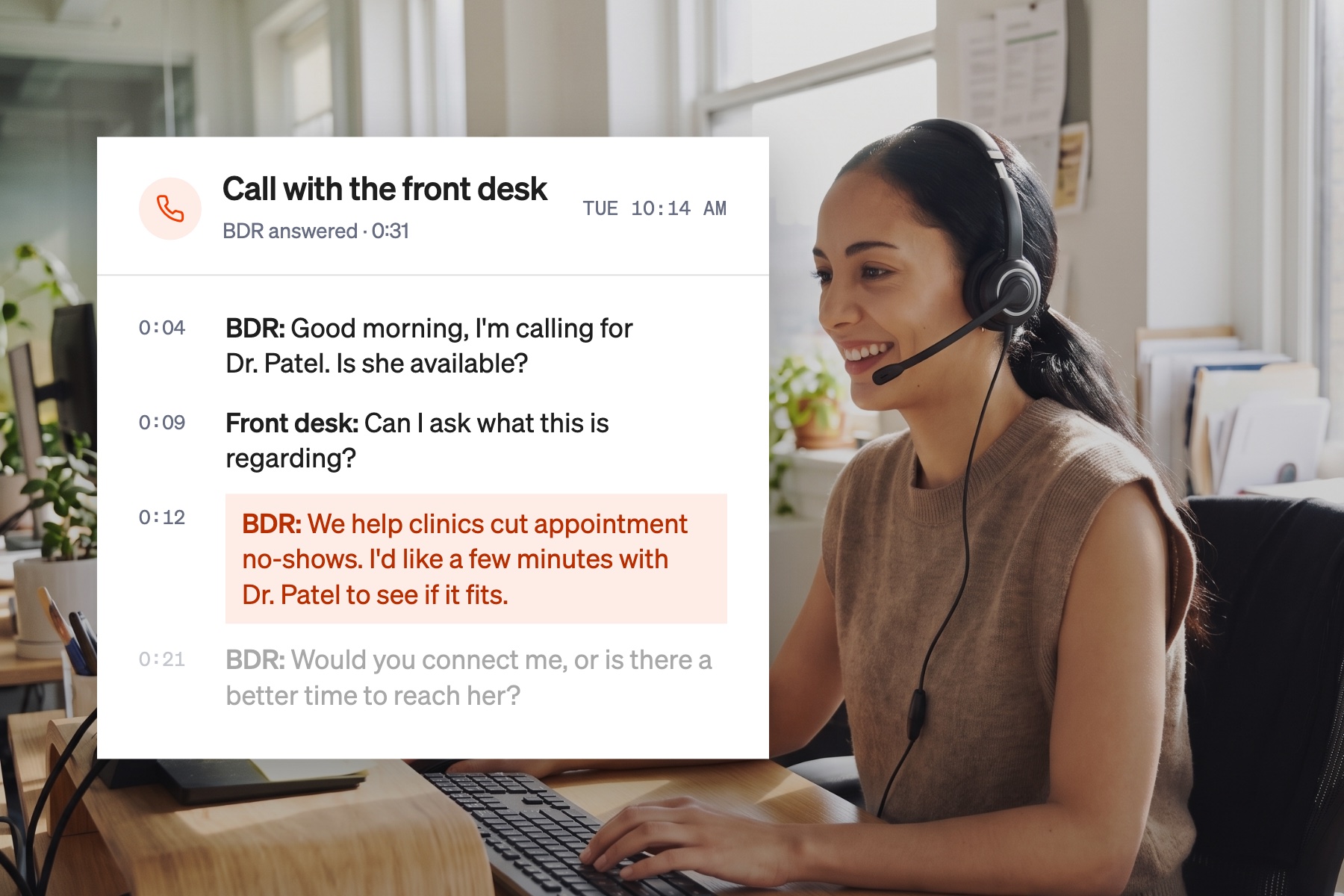
If you're asked what the call is regarding, say what you do and why it concerns that person, in one sentence: we work with [type of clinic] on [the problem you solve], and I'd like a few minutes with [contact name] to see whether it applies to [clinic name].
Then ask the question that gives the gatekeeper something to do: would you connect me, or is there a better time to reach [contact name]?
I understand, [contact name] is busy. Would it be better if I sent an email first? What's the best address? And so I don't keep interrupting you, is morning or afternoon better to try again?
You now have an email address, a time and a reason to call back. The gatekeeper gave you all three, which means the next call is expected.
Hi, this is [name] from [company]. I called a few days ago and you suggested I try back in the afternoon. Is [contact name] free?
If you're asked again what it's about, repeat the one sentence, add the one number that makes the call worth taking, and ask for a time.
If you're still blocked, thank them and send the email you offered. Assistants sometimes forward that email with a note of their own, which makes the next call warmer.
The tone points we drill with new BDRs are short. Be friendly. Acknowledge that the person is protecting a calendar. Offer an alternative. Leave with information even if you don't get through.
That last one is the difference between a call that was blocked and a call that moved. A blocked call with a name, an email and a callback time is progress. We log it that way.
It also keeps your number out of the spam pile. A caller who lies about knowing the boss gets remembered, and calls from that number start getting ignored or reported. We wrote about what happens when cold calls get flagged as spam and how long it takes to fix.
Timing moves the numbers more than any phrase does. Our timing study looked at 40,000 outbound calls over 90 days. Calls in the best windows connected up to 21.4% of the time. Calls after 5 p.m. connected 6.1% of the time.
Protect the late-afternoon window on your calendar. Before 8 a.m. and after 5 p.m. you sometimes reach the executive directly, but the data says you reach nobody far more often.
Direct dials. Good contact data includes direct and mobile numbers for many decision-makers. Use them, and when the person answers, say who you are and why you're calling in the first seven seconds. Our post on cold call opening lines covers that part.
Email first, then call. If the gatekeeper gave you an address, send a short note and call back two days later. Now the call has a reference point: I sent a note on Tuesday about [topic], and I wanted to see if it reached [contact name].
Ask the gatekeeper who owns the problem. Sometimes the person you asked for is wrong. Who handles vendor decisions for the lab, or who would look at a proposal on scheduling software, is a question an assistant will usually answer. You learn the right name and you've turned the gatekeeper into a source.
Don't claim you're returning a call you never received. Don't say it's personal. Don't use the executive's first name as if you're friends. Don't argue when you're told no. Don't call the same main line five times in a day.
Each of these works occasionally, which is why people keep teaching them. Over thousands of calls into the same industry, they cost more conversations than they win.
We track contact rate, meaning the share of dials that reach a decision-maker, separately from appointments set. On the Jan-Pro program it was 21%. On Moponic it was 18%. Across our programs it runs between 10 and 25%, depending on the industry and the list.
That number tells you whether the gatekeeper work is going well before the appointment count does. If contact rate drops, the fix is usually the opening line, the callback discipline or the calling window. If contact rate holds and appointments fall, the problem is further down the call, and our objection library is where we look next.
One sentence that says what you do and why it concerns the person you asked for. Then ask whether they can connect you or suggest a better time. Anything longer sounds like a pitch and gets screened.
Our data from 40,000 calls says late afternoon, 4 to 5 p.m., connects best, with late morning second. Calling after 5 p.m. to dodge the front desk reached someone 6.1% of the time.
Use the full name the first time. First names on their own signal familiarity you don't have, and assistants notice.
Call back when the gatekeeper told you to, and reference that conversation. Beyond three or four attempts on the main line, switch to email, a direct dial or a different contact at the company.
The structure is the same. The one sentence changes. In clinics the gatekeeper is often a practice administrator who is also a decision-maker, so treat the call as a conversation, not a hurdle.
Getting past the gatekeeper is one step in a call, and the step before it is a list with the right names on it. If you'd rather have a US-based team make these calls for you, our B2B cold calling services page explains how a program runs, and the appointment setting services page covers what a qualified meeting looks like when it lands on your calendar. The 12 steps of a successful cold call covers the rest of the conversation.
If you want to compare notes on your own contact rate, book a 25-minute conversation. If outbound isn't the right channel for what you sell, we'll say so.