






John Dubay
Managing Partner of Leads at Scale
Published on
July 16, 2021
GET AN ESTIMATE
Copy link


Are you wondering, “What is cold calling?” Cold calling has been used for marketing and sales by businesses for decades, and it hasn’t gone out of style yet. In fact, cold calling is still a very valuable marketing tactic, as long as it is used correctly. This is especially the case for B2B companies.
One major aspect to consider when implementing cold calling into your business is the script. All sales representatives, even the most talented, will need a frame of reference to go by. A cold calling script is a vital tool for cold calling within B2B companies.
But what exactly is cold calling? How does a cold calling script work, and is it even necessary? If you want to learn how to write a cold call script, we’ve got you covered. We put together an in-depth guide on how to cold call for sales, complete with some excellent examples. Take a look at our guide on how to write a sales script below!
[toc]
What Is Cold Calling?

Cold calling refers to the act of contacting someone, via email or phone, whom you have never contacted before with the intention of selling them a product or service. For B2B companies that use cold calling, the individual who is contacted is often associated with another business in a substantial way and is a key decision-maker for that business.
So what is a cold call in sales? Cold sales calls are conducted by sales teams and can vary significantly, but all have the intent of selling a product. Back in the day, cold sales calls with the intent to end the phone call with a sale were very common. However, they were not very successful. Nowadays, cold calling is more of a marketing technique with the intention of scheduling a call later on down the road. It is essentially an initial point of contact to get prospects interested in your business.
Now that we understand what is cold calling, let’s break down why cold calling scripts are worth investing time and money into.
Why Are Cold Calling Scripts Worth Creating?
When one hears the words “cold calling script,” one might imagine a group of sales rep drones who are just repeating the same phrases over and over. This should not be the intended use of cold calling scripts. Rather, such scripts can be used to provide context and a point of reference for sales reps. Cold calling is not about pumping out the same conversation over and over. It’s about providing reps with the tools they need for success. Without a script, you’re lacking a whole strategy.
What Is the Purpose of Cold Calling?

The purpose of cold calling is to “get your foot in the door” with business decision-makers, to take your prospects to the next level, where you can get their full attention. You can learn more about their needs and help them decide their next step.
How To Write A Cold Call Script
It’s much easier and often more effective to outsource your cold calling needs to a B2B cold calling service like Leads at Scale. However, if you want to prep your sales team and take on the job yourself, there are a few steps to take to write a cold call script.
Effective Cold Call Flow
The flow of your cold calling endeavors needs to be natural, but still, put the sales rep in control of the cold call.
Introduction
An introduction should be short, sweet, and to the point. “Hi, is this Robert at Culinary Care? This is Maude from Johnson Financial. I’ll keep this brief, since you’re busy--”
What’s in it for me?
Make your case quickly. Don’t focus too much on what your product does or who your brand is. Present them with a use case and describe how your product can fix their problem.
Call to action
A clear and concise call-to-action is the key to closing a successful cold call. Typically, your CTA should be something along the lines of, “Can I schedule you for a fifteen-minute call for next week?”
Propose a time to meet
Don’t keep the window wide open. Suggest a Tuesday, or an afternoon, or a mix of dates and times. This will give your prospect more direction.
Deliver on the value offer
When it comes to the time for that scheduled call, be sure to recall exactly what the use case, solution, and value offer was during the call with that prospect.
Cold Calling Script Template
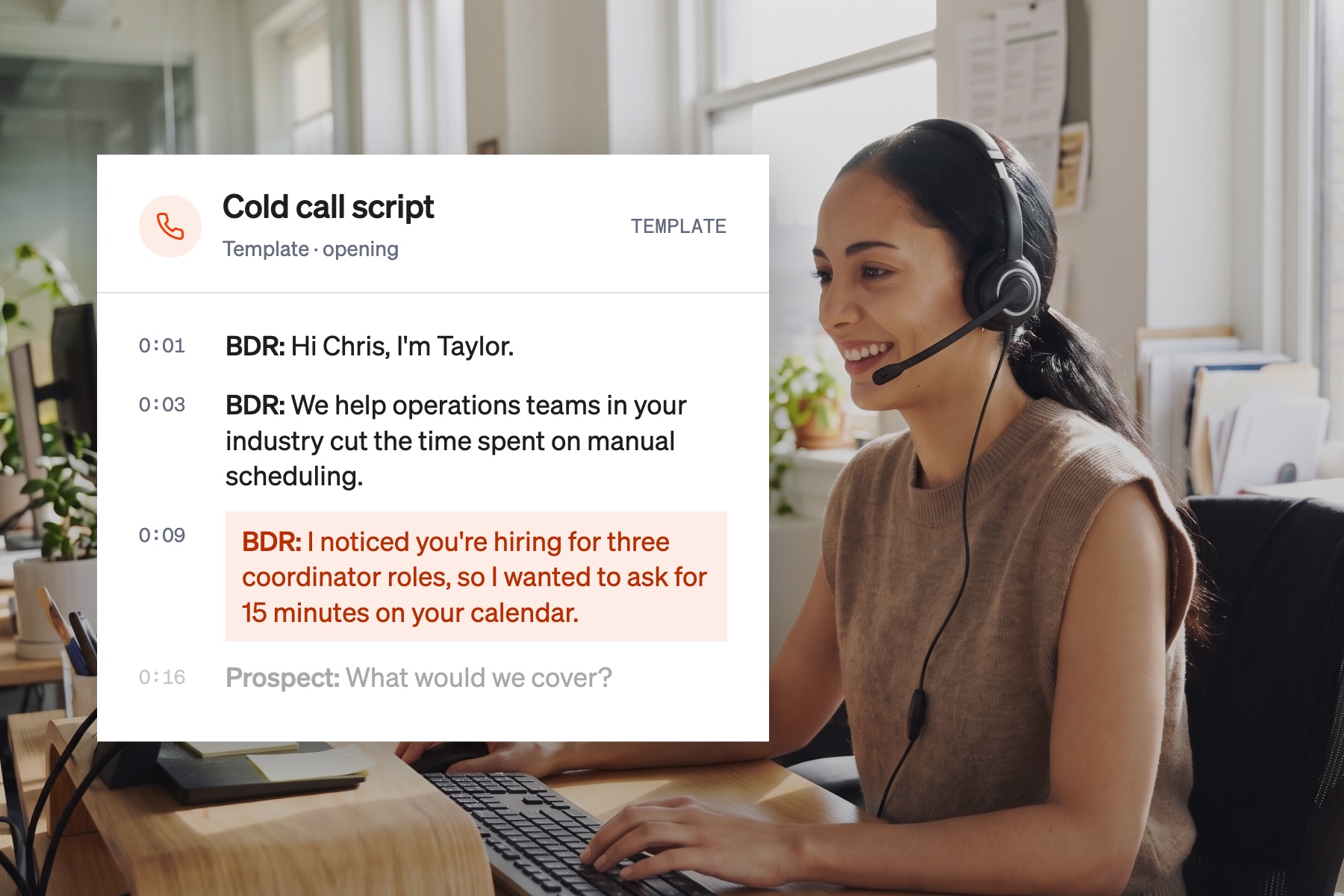
Your cold calling script template will be unique to your business. In general, though, your cold calling script template can follow a flow similar to the following:
“Hey there, [Prospect Name]. I’m [Sales Rep Name] from [Your Business]. We’re a [industry and brand] that helps companies in the [industry] niche to [relavent use case]. I’m calling to see if your company is in the neighborhood for a new [service or product you offer].”
“Hi, there. Is this [Prospect/Assistant Name] speaking? I’m [Sales Rep Name] from [Your Business], and I’m looking to get in touch with [Prospect Name] from [relevant department]. Could you connect us?”
“Hello, [Prospect Name]. My name is [Sales Rep Name] with [Your Business.] I’m calling because I want to get some time on your calendar if possible. I noticed that you’ve recently put out ads on a number of job boards to fill your [position] positions. It’s clear your company is scaling quickly, which is why I wanted to offer an opportunity to try [your product].”
Remember that your cold calling script should be tailored to your unique clientele and industry. Just as well, avoid any intense sales-y talk and approach your cold calls as an opportunity, not a telemarketing effort. Also, avoid asking “filler” questions to be chatty. Business owners and decision-makers are busy, so it’s best to get right to the point. And, as always, make sure you’ve gathered as much relevant information about the prospect as possible-- their name, position, business name, business industry, their assistant’s name, etc.
Examples of Sales Call Scripts
Need a little inspiration? The following examples are great cold calling script samples to get inspired by when penning your own cold calling scripts.
Cold Calling Script for More Engagement
“Hey Bob, this is Fred from Management Central here. How are you doing? Great! I appreciate you taking my call, and I’ll keep this short. I just wanted to give you a quick call because we’re currently doing a ton of work with hospitality businesses of a similar size to Travel Vita, and we’re seeing a lot of success in this industry with our product. We basically help hospitality businesses improve their management practices by offering them an all-in-one platform for scheduling, communication, payroll, things like that. Is Travel Vita struggling in this department?
Understandable. Hospitality management is tough. I really think our platform would help out quite a bit. Would you be interested in scheduling a quick fifteen-minute phone call for next week? Awesome. If you can give me your email, I’ll send over my calendar link so you can pick which date and time works best for you. If there’s anyone else that makes key decisions for products like this around, I’d love to have them on the call as well. Thank you so much for your time, talk to you soon!”
Cold Call Script for Project Management
“Hi, this is Georgia from Project Management Alpha. We haven’t met yet, but I was doing some research on businesses that may be a good fit for our project management platform and noticed we might be able to help Zion Publishing.
I know you’re busy, so I’ll keep this brief. Several of the companies we work with run into challenges in finding inexpensive and effective tools to manage their growing team members, many of which are indie publishers like Zion Publishing. Is this something you’ve experienced?
We’re a software startup that is dedicated to making project management tools that save time, improve productivity, and increase sales for small businesses. I’d love to set up fifteen minutes with you and anyone else from your team who would like to learn more. Does Tuesday or Wednesday afternoon next week work better for you?
Wonderful, I’ll send you my calendar link right away. Thank you for your time, I’m looking forward to meeting you!”
Cold Call Script for Connecting with Decision-Makers
“Hi, Samantha. This is Pam with DocuPen. How’s your Thursday going? I know you probably get a lot of calls, so I’ll make this fast. In a nutshell, we help businesses to reduce paperwork and improve the security of their documents. We do this by offering our digital platform, DocuPen, which is a cloud-based document uploading system. By digitizing documents and making uploads as seamless as possible without the need for fax machines or scanners, we’ve helped a lot of businesses in your exact niche handle their customer forms with added security.
Would you be open to the idea of just seeing how this works? Great! Just a quick question, Pam: Who else is involved in the decision-making process for something like our product?
If the prospect is interested, continue as below
Great, quick question though Samantha, who else is involved in the decision-making process for something like this? Would it make sense to have them take a look at this as well?
Fantastic. It sounds like we would be an excellent fit. How does your schedule look next Wednesday? I’m looking forward to meeting with you and your project manager!”
Cold Call Script for a Follow-Up
“Hi Vladimir, I’m Zachary, how are you today?
I’m calling because you had previously reached out to my business, Sunsville Accounting, and expressed some interest in our financial management system, so I wanted to reach out and see if you needed some help.
I’m sure you’re busy at the moment, so would you be interested in scheduling a fifteen-minute call sometime next week to discuss how our product could help Johnstown Union Bank? Excellent! I’m sending my calendar link to the email address you use to connect with us. My schedule is wide open, so please pick whatever date is the most comfortable.
Thank you so much for your time! I’m looking forward to talking about how Sunsville Accounting could help you out.“
How was our guide to cold calling for B2B companies? If you need some extra help with your cold calling and marketing, a B2B lead generation agency like Leads at Scale can help. Get in touch with our team today!
See what a program would look like for your market
Book 25 minutes with us. We'll tell you what we'd do, what it would cost and whether we think it's worth it for you.
Schedule a Conversation
Hiring an SDR vs outsourcing
FACTOR
IN-HOUSE SDR TEAM
OUTSOURCED SERVICE
Experience
Often a new hire learning to cold call
SDRs with years of training and thousands of calls
Reaching decision-makers
Learned by trial and error, on your list
Know the call patterns that reach decision-makers
Cost
Often north of $80,000 a year, fully loaded
Programs start around $3,000 a month
Time to start
Hiring, then 3 to 6 months of ramp
A few weeks of setup
Management
Your manager's time, plus hiring and training
No one to hire or manage
When a rep quits
You rehire and ramp again
You aren't left short
"If you manage outsourced cold calling like a call center, you'll get call center outcomes. Manage it like a revenue team, and you'll get pipeline."
John Dubay
Managing Partner, Leads at Scale
Related Articles

7 Proven Sales Prospecting Techniques & Tips
Read Article

Why Follow-Up Frequency Matters in Sales
Read Article

Essential B2B Sales Strategies for Building Strong Relationships
Read Article
John Dubay
Managing Partner, Leads at Scale
John has helped B2B companies book over 50,000 sales appointments since 2010. He writes about lead generation, appointment setting, and sales development.

Follow on LinkedIn
