



Cold Calling Objection Library: 50 Responses That Work
Master cold calling with effective objection handling strategies and 50 tailored responses to turn challenges into opportunities.



Cold calling is tough, but handling objections well can make all the difference. Objections like "I'm not interested" or "We don't have the budget" are common, yet they often signal engagement, not rejection. The key? Listen, clarify concerns, and respond with solutions that matter to the prospect. Here's a simple, proven framework to handle objections effectively:
This guide includes 50 responses tailored to objections like "No budget", "Already have a vendor", or "Not interested." Use these strategies to build trust, qualify leads, and improve your sales outcomes. Cold calling success starts with preparation and thoughtful conversations.
Handling objections during a cold call can feel daunting, but having a structured approach makes all the difference. This three-step framework helps you stay in control, build trust, and respond effectively - without scrambling for answers or sounding defensive.
Start by truly listening. Let the prospect speak without interruption, giving them the space to fully express their concerns. Pay attention to their tone and choice of words - it can reveal a lot about what’s really on their mind. For instance, a frustrated "We don't have the budget" might suggest they wish they could afford your solution, while a neutral "We don't have the budget" could indicate they don’t see value in what you're offering.
Use verbal cues like "I understand" or "That makes sense" to show you're actively engaged. These small acknowledgments demonstrate you're genuinely processing their words, not just waiting for your turn to speak. This approach sets you apart from the overly pushy salespeople they may be used to.
It’s also important to let them finish because prospects often share the most critical details toward the end of their explanation. Interrupting not only risks missing these insights but also sends the message that you don’t value their concerns - making it harder to build rapport.
Once they’ve finished, move to clarifying their objection. This step ensures you’re addressing the real issue, not just what’s on the surface. Ask targeted questions to dig deeper. For example, if they say, "We’re not ready", clarify whether they mean they’re not ready this quarter, this year, or they need more proof that your solution works.
Here’s how you might approach it: Instead of accepting "We don’t have the budget" at face value, ask, "Is this about not having funds allocated for this type of solution, or is it more about timing with your current budget cycle?"
Another effective technique is paraphrasing. Repeating their concern in your own words shows you’ve been listening and helps confirm you’ve understood correctly. For instance, you could say: "If I’m hearing you right, it sounds like you’ve had issues with vendors not delivering on their promises before, and you want to ensure that doesn’t happen again. Is that correct?"
This step not only demonstrates your attentiveness but also helps uncover additional details that could shape your response. Sometimes, just talking through their concerns helps prospects rethink their objections on their own.
Now it’s time to address their concern directly - always focusing on what’s relevant to them. Avoid generic answers that could apply to anyone. Instead, connect your solution to their specific situation and explain how it resolves their problem.
For example, if they’re worried about implementation time, don’t rattle off a list of product features. Instead, share how quickly similar companies have seen results and highlight the support you provide during transitions. If they’re in manufacturing and concerned about downtime, mention how you’ve helped other manufacturers minimize disruptions. For startups worried about scalability, emphasize how your solution adapts to their growth.
Keep your response short and to the point. Address their concern, provide a quick example or proof if applicable, and check if you’ve eased their worry. You might say: "Does this address your concern about implementation time?"
Use the listen, clarify, and respond with value framework to navigate the objections below. Cold calls often come with pushback, but knowing how to handle objections effectively can turn these moments into opportunities. These objections and responses are grouped by category, making it easier to find the right approach for any scenario.
These responses are designed to transform an initial "no" into a chance to explore potential needs. Research shows that 60% of cold calls encounter the "I'm not interested" objection, which is often more of a reflex than a genuine refusal.
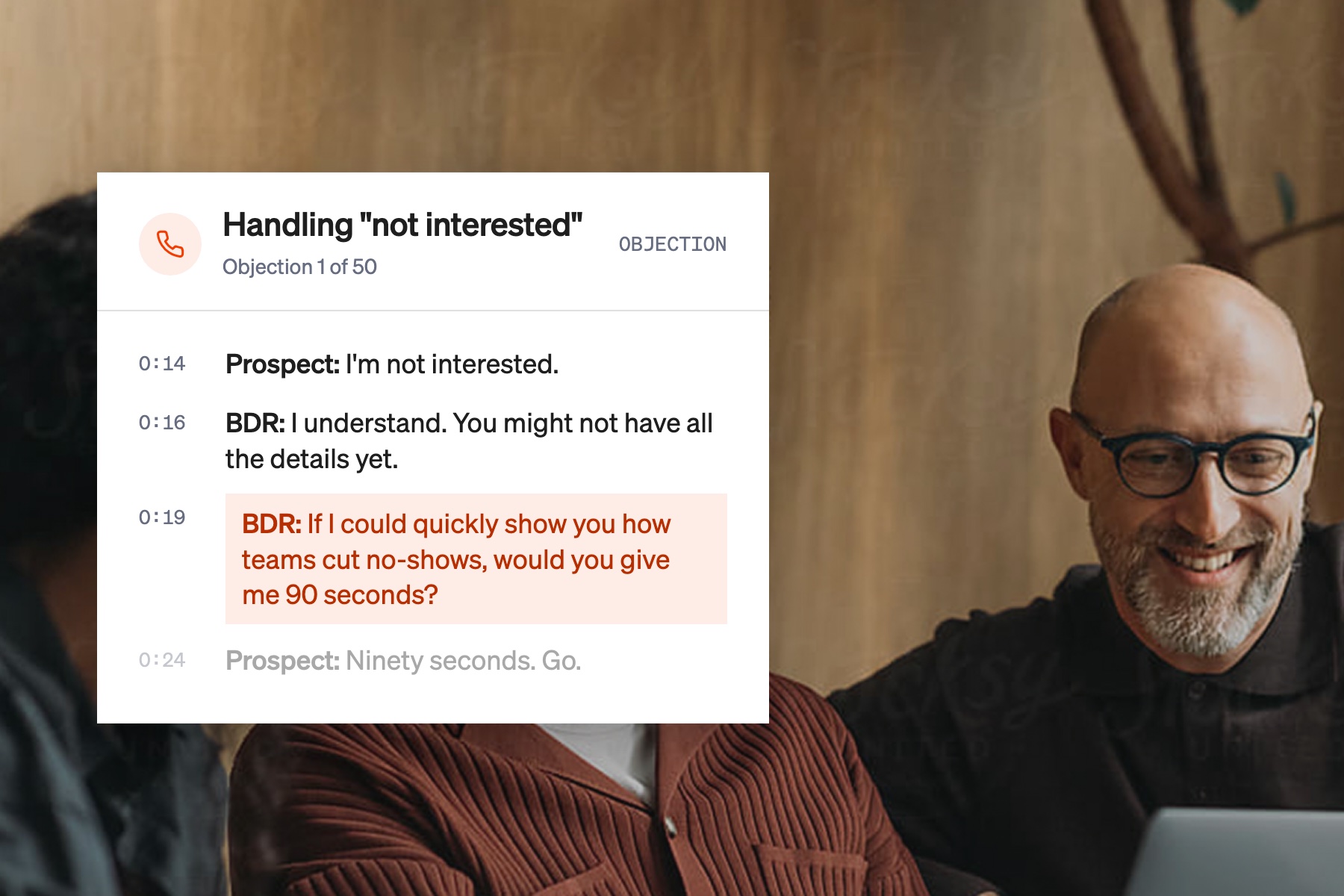
Objection 1: "I'm not interested."
Response: "I understand - you might not have all the details yet. If I could quickly show you how to [specific benefit], would you give me 90 seconds?"
Objection 2: "We don't need this right now."
Response: "That's exactly why I'm reaching out. Many of our clients weren’t actively looking for a solution either but later realized the unexpected benefits."
Objection 3: "I'm too busy to talk."
Response: "I get it - your time is valuable. What I have to share has helped busy professionals save time. Could I take 90 seconds to explain?"
Objection 4: "Not interested in what you're selling."
Response: "I hear you. Sometimes, though, I help uncover challenges that aren’t immediately obvious. What’s your biggest concern with [relevant business area]?"
Objection 5: "We've tried similar solutions before."
Response: "That’s understandable. What didn’t work about your previous approach? Many companies later tell us they wish they’d known about our method sooner."
Objection 6: "I don't take cold calls."
Response: "I get it - cold calls aren’t ideal. I’m reaching out because companies like yours are seeing [specific result]. Before I go, could you share what you’re currently doing for [relevant business function]?"
Objection 7: "Send me an email instead."
Response: "Emails can only go so far. Could I ask one quick question that might shift your perspective on [relevant topic]?"
Objection 8: "I'm not the decision maker."
Response: "That’s fine - I’m not asking for decisions today. I’d just like to learn if this might be relevant for your team. Who typically handles [relevant business area] decisions?"
Objection 9: "We're happy with how things are."
Response: "That’s great to hear. I’m not suggesting you change what’s working, but if you could significantly improve [specific metric] without disrupting your process, would that interest you?"
Objection 10: "I don't have time for this."
Response: "I completely understand. But let me ask - if I could show you a way to save time, would a quick conversation be worth it?"
Budget objections often reflect broader concerns rather than just financial constraints. With 77% of B2B buyers describing their last purchase as complex, these responses aim to address those underlying challenges.
Objection 11: "We don't have budget for this."
Response: "Is this about not having funds for the solution, or is it more about timing?"
Objection 12: "It's too expensive."
Response: "I haven’t shared pricing yet. Often, the cost of not solving [problem] is higher. What’s that costing you now?"
Objection 13: "We need to wait until next quarter."
Response: "If I could show you a quick ROI that changes your timeline, would you reconsider? Many clients wish they’d started sooner once they saw the benefits."
Objection 14: "The budget is frozen."
Response: "That’s tough. When you say ‘frozen,’ does that include investments with a proven ROI? Many clients justify decisions like this when the return is clear."
Objection 15: "We spent our budget on other priorities."
Response: "That’s common. What were those priorities, and how are they working out? Sometimes our solution enhances other initiatives you’ve already invested in."
Objection 16: "I need to see ROI first."
Response: "Absolutely - a smart approach. Our typical client sees [specific metric improvement] within [timeframe]. What ROI benchmark would make this a no-brainer for you?"
Objection 17: "We're cutting costs right now."
Response: "Focusing on cost-cutting is often the best time to explore solutions like this. We help companies reduce [specific cost area] by an average of [percentage]. What’s your biggest cost challenge?"
Objection 18: "The CFO won't approve new spending."
Response: "CFOs value quick returns. Our solution often shows positive cash flow within [timeframe]. What criteria does your CFO use to evaluate investments?"
Objection 19: "We need to compare options first."
Response: "That’s a smart approach. What matters most in your evaluation? I’d love to make sure you have all the right information."
Objection 20: "It's not in this year's budget."
Response: "Budget cycles can be tricky. When does planning for next year start? Do you have any discretionary funds for solutions with immediate impact?"
With an average B2B buying group involving 12 stakeholders, existing vendor relationships can be complex. These responses help navigate those situations.
Objection 21: "We already have a vendor for this."
Response: "That’s great - it shows you see value in these solutions. How’s it working out? Many of our clients use us alongside their current vendor because we offer [specific differentiator]."
Objection 22: "We're locked into a contract."
Response: "Contracts are important. When does your agreement end? Are there gaps in your current solution we could address in the meantime?"
Objection 23: "We're happy with our current provider."
Response: "What do you like most about working with them? If you could change one thing, what would it be?"
Objection 24: "We just signed with someone else."
Response: "Congrats on making a decision - that’s often the hardest part. What led you to choose them, and how’s the implementation going?"
Objection 25: "Our current vendor does this too."
Response: "They might, but let me ask - are you consistently hitting [specific result]? Many companies find room for improvement there."
Objection 26: "We built this internally."
Response: "Internal solutions can work well initially. How much time does your team spend maintaining it? Often, internal resources could be better used on core activities."
Objection 27: "We're in the middle of implementing something else."
Response: "That’s a busy time. How’s it going so far? Sometimes we complement new initiatives to help ensure success."
Objection 28: "Our IT department handles this."
Response: "IT teams do great work, but they’re often stretched thin. Do they have the bandwidth to address [specific challenge] effectively?"
Building on the foundation of listening, clarifying, and emphasizing value, effectively handling objections isn’t just about what you say - it’s also about how you say it. These practices will help you deliver responses that resonate while maintaining strong professional relationships, setting the stage for long-term success.
When addressing objections, brevity is key. Prospects raising concerns are already hesitant, and lengthy explanations can increase their resistance. The goal? Tackle their concern quickly and redirect attention to the value you bring.
Start by acknowledging their concern, clarify it to ensure understanding, and then pivot to a benefit that directly addresses their needs. For instance, instead of saying, "Our solution is comprehensive", try something more tangible like, "This can significantly cut down your monthly reporting time." Concrete, specific benefits resonate more than vague claims.
End your response with a question to keep the conversation flowing. For example, after addressing their concern, you might ask, "Does that align with what you're looking to achieve?" This keeps prospects engaged and often uncovers deeper objections, turning the discussion into a collaborative problem-solving session rather than a defensive exchange.
Your tone and energy carry as much weight as your words. Prospects can pick up on frustration or desperation, which can undermine your credibility and derail the conversation.
Take a brief pause before responding. This not only shows you’re listening but also helps you avoid reacting emotionally. Matching the prospect’s tone and pace is another effective way to build rapport. If they’re direct and fast-paced, keep your responses sharp and to the point. If they’re more deliberate, slow down and provide additional detail.
Avoid arguing or dismissing their objection outright. Instead, use validating phrases like "I understand" or "That makes sense." This approach helps reduce defensiveness, making them more open to hearing your perspective.
Improving how you handle objections requires consistent evaluation. Keep a simple record of common objections and note what works - and what doesn’t - in your responses. Over time, patterns will emerge, helping you refine your strategy.
For example, if budget concerns frequently come up, analyze how you’ve addressed them in the past. Did a particular response keep the conversation alive? Use those insights to adjust and strengthen your approach.
Practice makes perfect. Rehearse your responses until they feel natural and conversational, not robotic or overly rehearsed. Recording and reviewing your calls can help you fine-tune your tone and delivery. Role-playing with colleagues using real objections can also provide fresh perspectives and new strategies.
Finally, regularly revisit and update your responses. As you learn more about your prospects and their challenges, adapt your strategies to stay relevant. Documenting successful approaches, including what you said and how the prospect reacted, can serve as a blueprint for future calls. These practices ensure you’re always prepared to handle objections with confidence and effectiveness.

The strategies for handling objections covered here aren't just abstract ideas - they're practical tools that sales teams use to get tangible results. By applying these methods, you can improve your cold calling outcomes. Here's how Leads at Scale puts these techniques into action to deliver real results.
Leads at Scale's US-based Business Development Representatives rely on a proven three-step process to handle objections effectively. This approach helps them maintain higher contact rates with decision-makers and turn more prospects into qualified appointments.
Rather than jumping straight into a pitch, their sales representatives start by acknowledging the prospect's concerns and asking clarifying questions. This helps uncover the root of the objection - often revealing that the prospect may not fully understand the value being offered or might have some misconceptions about the service.
When faced with budget objections, the team shifts the focus from cost to return on investment (ROI). Instead of debating price, they steer the conversation toward the revenue impact and cost savings their clients typically experience. This reframes the discussion, making it more about value and less about spending, which often leads to a more open dialogue.
For objections like "we already have a vendor", their sales reps take a consultative approach. They ask questions about the prospect's satisfaction with their current solution and explore any gaps that might exist. This method turns what could be a dead-end objection into an opportunity for deeper engagement and meaningful discussions.
In addition to personal techniques, Leads at Scale leverages advanced campaign features to strengthen objection management efforts:
Additionally, detailed prospect data helps refine future messaging. By tailoring approaches to specific industries or company sizes, the team proactively addresses common concerns in future interactions.
These refined techniques and features have a direct impact on sales pipeline performance. By effectively handling objections, sales teams uncover genuine buying intent and speed up the sales cycle. This leads to higher lead qualification rates and better close rates.
The result? Stronger sales pipelines with more high-quality appointments and shorter sales cycles. Prospects who have their concerns addressed early on are more engaged during follow-up discussions, making them more likely to move efficiently through the pipeline and ultimately close.
Companies that partner with professional lead generation services often see these benefits within just a few months. With skilled objection handling, targeted outreach, and systematic follow-ups, the sales process becomes more predictable and delivers consistent results over time.
Turning cold calling into a strategic advantage hinges on mastering objection handling. The 50 responses shared in this guide offer a solid starting point for tackling the most common challenges sales professionals face during prospecting. But here’s the real takeaway: success lies in understanding the principles behind these responses, not just memorizing lines.
Let’s revisit the core framework - listen, clarify, and respond with value. This approach isn’t just about handling objections; it’s about fostering authentic conversations that build trust and pave the way for meaningful discussions about a prospect’s needs and potential solutions.
When you approach objections this way, they stop being roadblocks and start becoming opportunities. They can lead to discussions about ROI, uncover scheduling possibilities, or even provide insights into a prospect’s satisfaction with their current vendors. Every objection reveals something valuable about the prospect’s priorities and challenges.
The secret? Preparation and adaptability. Having a set of proven responses at your fingertips can boost your confidence, but the best salespeople go beyond that. They actively listen, adapt their approach, and address the underlying concerns or misconceptions hidden within objections.
Combine this skill with targeted prospecting, thorough research, and consistent follow-ups, and you’ll see a sharper sales pipeline and shorter sales cycles.
And don’t forget - practice makes perfect. Track the objections you encounter most often, experiment with different responses, and refine your strategy based on what works best. Over time, you’ll see improvements that not only increase contact rates but also accelerate deal closures, driving real growth for your business.
To make the 'listen, clarify, and respond with value' method work during cold calls, start by truly listening to what the prospect has to say. Let them express their concerns without cutting them off. This not only shows respect but also gives you a clear understanding of their objections.
Then, clarify their concerns by asking open-ended questions. For instance, you could ask, "Could you tell me more about the challenges you're dealing with right now?" or "What has made solving this issue tricky in the past?" These types of questions help build trust and dig deeper into the reasons behind their hesitation.
Finally, respond in a way that adds value by offering a solution tailored to their specific situation. Share relevant examples, data, or success stories to illustrate how your product or service can address their needs. Keep your explanation focused and to the point to keep the conversation productive and engaging.
Avoiding missteps during cold calls is crucial to keeping the conversation on track and professional. Here are some common mistakes to steer clear of:
By staying organized, confident, and tuned into the prospect's needs, you can handle challenges better and create meaningful connections.
To assess how well your objection-handling techniques are working, take a close look at your sales calls. Focus on the objections prospects bring up and how they react to your responses.
Keep an eye on important metrics like conversion rates, follow-up success, and deal closures to determine if your approach is leading to better results. Reviewing call recordings regularly can help you spot trends, adjust your strategies, and make sure you're tackling objections in the best way possible.
By maintaining consistency and committing to improvement, you can track your progress and sharpen your methods to boost your sales performance.